
Ontario Housing Market Update: Waterloo Region, Halton, Peel & Guelph

September was a paradox month. Home prices fell across every one of our focus regions, and yet the monthly payment on a typical Kitchener-Waterloo home went up by about $169. Here is what happened, why it happened, and what it means for your next move.
Key Takeaways
- → Like-for-like KWC prices fell about 6.6%, but the median monthly payment rose roughly $169 on higher fixed mortgage rates.
- → KWC: median $662,500 (down 3.6%), 282 sales (down 12%), 3.8 months of inventory, selling at 98.9% of asking.
- → Condos are the soft spot everywhere: KWC median down 18.8%, Guelph at 7.6 months of condo inventory, Peel's condo median down $51,000 in a single month.
- → Halton was the steadiest market in the GTA: benchmark down just 3.4%, selling at 96% of asking.
- → Peel: 936 sales at an average of $906,719, benchmark down 4.8%, 4.9 months of inventory.
- → Guelph held flat at 134 sales; the average rose 1.2% but the median slipped 2%, so the sales mix did the lifting.
- → The Bank of Canada held at 2.25% for the seventh straight time. Fixed rates rose because bond yields rose, not because the Bank moved.
- → Fresh this morning: Canada lost 68,000 jobs in September, unemployment ticked up to 6.5%, and markets price about a one-in-three chance of a rate hike at the Bank's October 28 meeting.
The Bigger Picture: GTA Sales Down, Prices Still Slipping
TRREB reported 5,040 GTA sales in September, down 9.0% from a year ago, at an average price of $1,006,409, down 5.1%. New listings fell 14.4% and active listings eased 9.3% to 26,131, but the benchmark composite still slipped 4.7% year over year. Condos were the weakest segment at down 7.7%. The pattern from June has broken: that month's 9.4% sales rebound suggested demand was thawing, but September's 9% drop shows buyers retreating as fixed rates climbed through the month. This is no longer a delayed recovery. It is demand going back into hiding.
Waterloo Region: Kitchener, Waterloo & Cambridge
Waterloo Region sits outside TRREB coverage, so the official read comes from Cornerstone data, with the sharpest signal from WRX Property Group's like-for-like analysis: similar homes changing hands for about 6.6% less than a year ago, against a headline median decline of just 3.6%. The mix of what sold flattered the headline.
|
$662,500
Median sold price
-3.6% YoY
|
$689,844
Average sold price
-6.8% YoY
|
282
Firm sales
-11.6% YoY
|
|
98.9%
Sale to list
21 median days
|
3.8
Months of inventory
down from 4.0
|
-6.6%
Like-for-like price
WRX model
|
Detached vs condos: two different markets
Detached homes held up. The median detached sold for $750,000, down just 2%, with 175 sales and 43.4% going over asking. Condo apartments are the soft spot: median $332,875, down 18.8%, sitting for a median of 48 days, with only 4 of 38 sales over asking. By city, Kitchener's median was $635,000 (down 6.6%) and Waterloo's $720,000 (down 1.4%).
The $169 payment math
| Median home price, Sept 2026 | $662,500 |
| Best 5-year fixed, then vs now | 3.79% → 4.34% |
| Monthly payment, a year ago | $2,467 |
| Monthly payment, today | $2,635 |
| Difference | +$169 / month |
Assumes 20% down payment on a 30-year amortization, using best available 5-year fixed rates (Ratehub). Estimates only, not mortgage advice.
Halton Region: Burlington, Oakville, Milton & Halton Hills
Halton was the steadiest market in the GTA for the second straight quarter. September brought 502 sales at an average of $1,139,025, changing hands at 96% of asking. The composite benchmark slipped just 3.4% year over year, the mildest decline of any TRREB region, with detached down 3.6%, townhouses down 7.4% and apartments down 5.1%. At well over a million on average, Halton remains the priciest of our focus areas and the most resilient.
Peel Region: Mississauga, Brampton & Caledon
Peel saw 936 sales in September at an average of $906,719, with 4.9 months of inventory, the loosest of our focus regions alongside Guelph's condo segment. The composite benchmark fell 4.8% year over year, with apartments down 8.1%, the sharpest condo decline among the regions we track. The eye-catching number: one reading showed Peel's median condo price dropping $51,000 in a single month from August, a sign sellers are finally adjusting to what buyers will actually pay.
Guelph
Guelph was the flat market of the month: 134 homes sold, essentially matching last September's 135. The average price reached $794,416, up 1.2% on the year, but the median slipped 2% to $745,000, which tells you the sales mix did the lifting rather than broad appreciation. Inventory sits at 4.2 months overall. The condo story mirrors KWC: average condo price $552,448, down 6.5%, with 37 sales taking a median of 53 days and 7.6 months of inventory, firmly buyer's territory.
All Four Regions, Side by Side
| Region | Price (Sept 2026) | YoY | Sales | Inventory |
|---|---|---|---|---|
| Waterloo Region | Avg $689,844 | -6.8% | 282 | 3.8 mo |
| Halton Region | Avg $1,139,025 | -3.4% (benchmark) | 502 | — |
| Peel Region | Avg $906,719 | -4.8% (benchmark) | 936 | 4.9 mo |
| Guelph | Avg $794,416 | +1.2% | 134 | 4.2 mo |
| GTA (TRREB) | Avg $1,006,409 | -5.1% | 5,040 | — |
Why Payments Rose When the Bank of Canada Did Nothing
This part surprises people. The Bank of Canada has not raised rates. The policy rate has sat at 2.25% for nearly a year through seven straight holds, with the next decision on October 28.
Fixed mortgage rates moved up because bond yields moved up. The 5-year Government of Canada bond yield sits near 3.6% to 3.7%, up roughly a full percentage point from a year ago, and touched a 52-week high in late September. Lenders price 5-year fixed rates off that yield, not off the Bank of Canada. Different lever, same result for your payment.
Economic snapshot: jobs, tariffs, and October 28
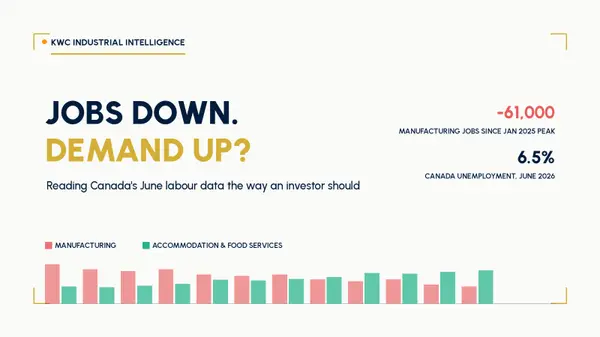
Jobs: Statistics Canada reported this morning that Canada lost 68,000 jobs in September, the second straight monthly decline, and unemployment ticked up to 6.5%. Manufacturing shed 13,000 jobs, giving back August's gain. The participation rate fell to 64.8%, its lowest since 1997 outside the pandemic.
Tariffs: The release doesn't name them, but here is one fingerprint: manufacturing shed 13,000 jobs in September, erasing August's entire gain. That matters more in KWC than the national number suggests. This region's economy runs on manufacturing, from auto parts to food processing, and factory hiring freezes show up in local housing demand a quarter or two later. Tariffs hit the factory floor first and your street's sold prices second. The Bank of Canada said in September that new US tariffs and Canadian countermeasures have made growth "more uncertain" while raising the risk of higher inflation. That is the Bank's dilemma in one sentence: tariffs threaten growth and inflation at the same time.
Rates: The Bank decides October 28. A hold at 2.25% is the base case, but markets price about a one-in-three chance of a hike to 2.50%, and the September inflation report on October 19 is the swing factor. Either way, fixed mortgage rates are moving on bond yields, and the 5-year yield just hit a 52-week high near 3.73%.
A softening job market plus sticky inflation is the exact mix that keeps both buyers and the Bank of Canada cautious. I'll be writing a full breakdown of what the tariff fight means for Ontario housing soon.
What This Means If You're Buying or Selling
For buyers
Lower prices without lower payments means the real win is choice and negotiating room, not a cheaper month. Condos across all four regions are deep in buyer territory, which rewards patience and sharp offers. In KWC, correctly priced homes still sell at 99% of asking in about three weeks, so the opportunity is in the overpriced listings that sit, not in waiting for the market to fall further.
For sellers
Price to the current data, not last year's. September showed what overpricing costs right now: KWC condos sat a median of 48 days while detached homes moved in 21, and Peel's condo median fell $51,000 in a single month as sellers adjusted to what buyers will actually pay. In Guelph, condo sellers face 7.6 months of competing inventory. The market isn't punishing sellers. It's punishing last year's price.
Frequently Asked Questions
Are Kitchener-Waterloo home prices still falling?
Treat the 6.6% as a midpoint, not a precise figure: the WRX model puts the likely range at 4% to 9%. The number to watch in the October data is whether detached, down just 2% so far, starts following condos down. That is what would turn a correction into a broad decline.
Why did my mortgage payment go up if prices fell?
The $169 math is for fixed rates. If you are variable, nothing has changed yet: prime is still 4.45% because the Bank hasn't moved. Your risk is October 28, where markets price about a one-in-three chance of a hike to 2.50%.
Is Halton still the steadiest market?
On the surface, yes. Underneath, the segments are splitting: townhouses down 7.4% while detached is down 3.6%. Halton's steadiness is concentrated in detached homes; attached homes are feeling the same pressure as Peel.
Are condos a good buy right now?
Buyers hold the leverage: 6.9 months of condo inventory across Waterloo Region, 7.6 in Guelph, and 48 median days to sell in KWC. The real question isn't price, it's duration. Buying works if you can hold through the soft patch, because a near-term resale means competing with motivated sellers.
Recent Posts