
Why Most Realtors Give Bad Advice (And How to Spot a Good One)
Why Most Realtors Give Bad Advice (And How to Spot a Good One)
Here's the claim, stated plainly: most real estate advice you get from an agent is optimized for getting the transaction done, not for getting you the right outcome. That's not an accusation that most agents are bad people. It's an observation about what the commission structure rewards, and people respond to incentives whether they mean to or not.
If that sounds cynical, look at the data before you decide it's wrong.
The Bias Is Measurable, Not Hypothetical
Economists Steven Levitt and Chad Syverson studied roughly 98,000 home sales in suburban Chicago, comparing homes real estate agents sold for their own account against homes the same agents sold for clients. The pattern was consistent and large: agents held their own homes on the market 9.5 days longer on average, and sold them for 3.7% more, than they achieved for clients in comparable transactions.
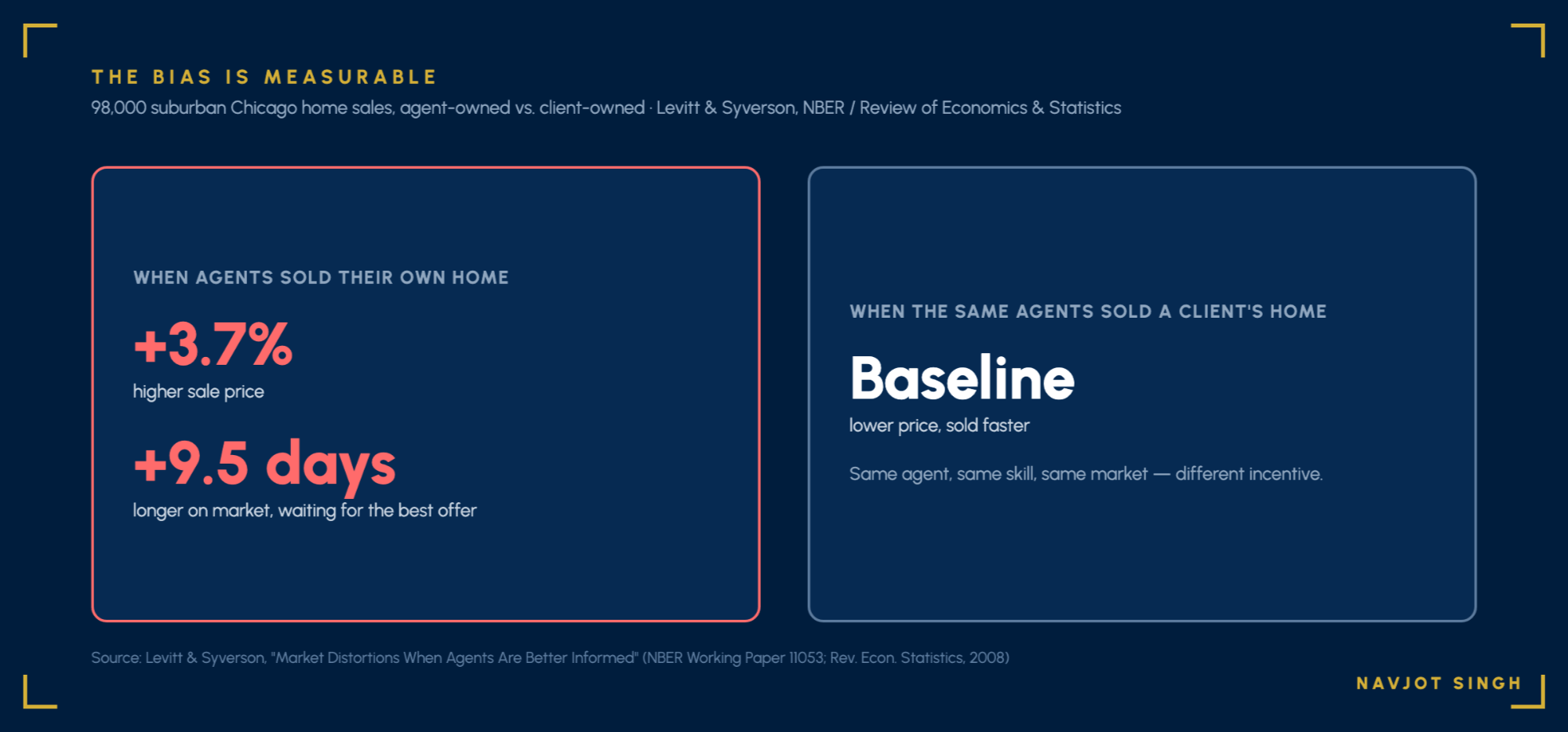
Same agents. Same skill set. Same local market. The only variable that changed was whose money was on the line. When it was their own, they held out for a better number. When it was a client's, the math that makes sense for an agent — close it, get paid, move to the next file — won out more often.
Separate research on dual agency — where one agent or brokerage represents both sides of a deal — has found measurable price distortions in some markets, and the Consumer Federation of America has flagged "double-dipping" commission structures as a source of overcharging in an analysis of thousands of transactions. The specific numbers vary by study and jurisdiction. The direction of the problem doesn't.
The Legal Standard Says Advisory. The Incentive Says Selling.
Here's what makes this more than an ethical shortcoming: real estate agents in both the US and Canada are already bound by fiduciary duty, the highest standard of client care recognized in law. In the US this is commonly summarized as the "OLD CAR" framework — Obedience, Loyalty, Disclosure, Confidentiality, Accounting, Reasonable Care — codified by state real estate regulators. In Canada, REALTOR® members are bound by the CREA REALTOR® Code and, in several provinces, by codified duties like Section 30(a) of BC's Real Estate Services Rules requiring an agent to act in the client's best interest.
Fiduciary duty is a higher bar than the "suitability" standard that governs most commission-based financial advisors, where a recommendation only has to be reasonable, not optimal. Real estate agents are legally held to the stricter standard. The incentive structure they operate inside frequently behaves like the looser one anyway.
Reform Hasn't Fixed the Incentive
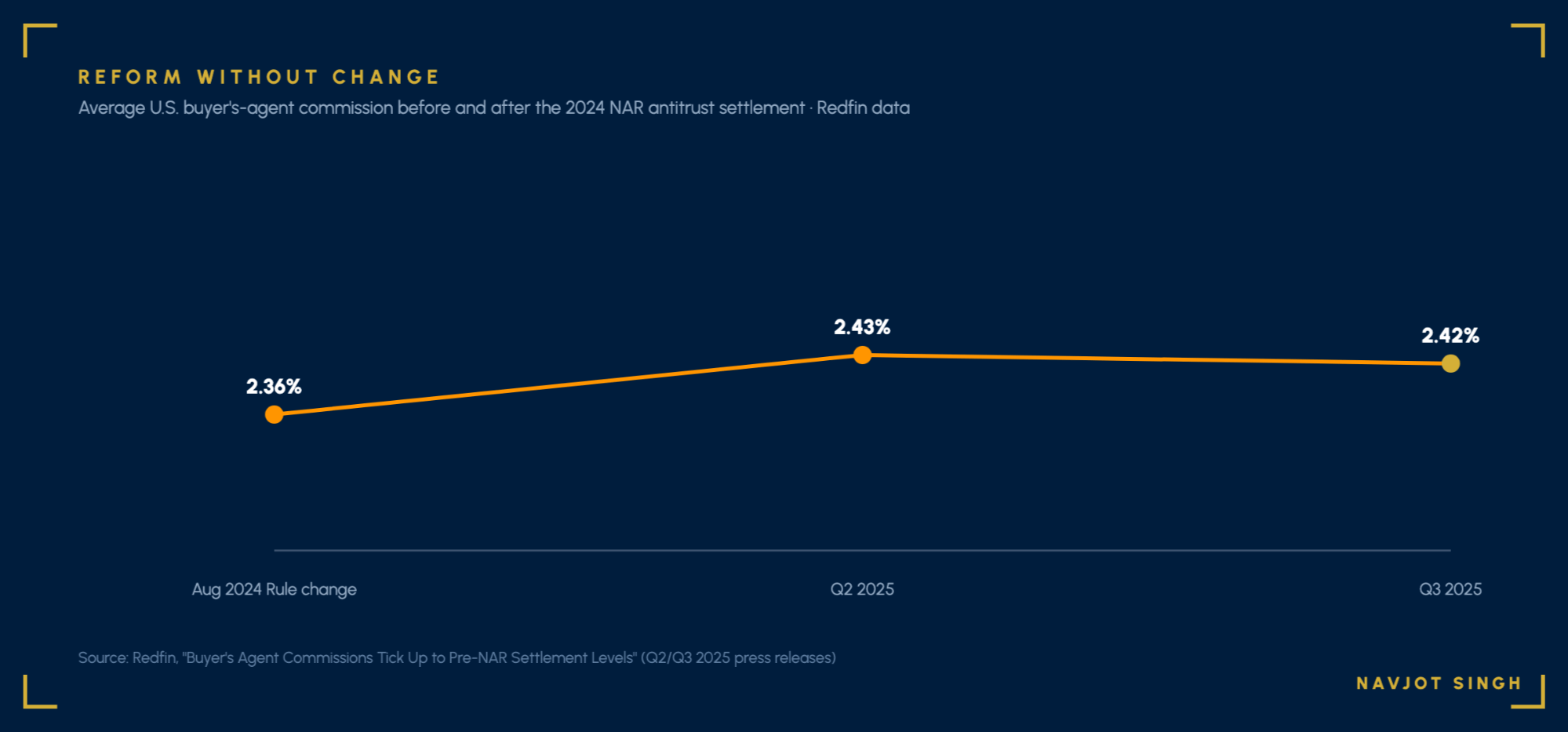
In 2024, the National Association of Realtors settled a landmark antitrust case for $418 million, agreeing to structural changes meant to make buyer-agent commissions more transparent and negotiable — no more blanket compensation offers baked into the MLS, and a written buyer agreement required before an agent can even show a home. The reform took effect August 17, 2024.
Here's the part that should give every buyer pause: it didn't meaningfully change what buyers actually pay. Redfin's own transaction data shows the average buyer's agent commission was 2.36% at the rule change, and had climbed back to 2.43% by Q2 2025 and 2.42% by Q3 2025 — effectively unchanged, over a year after a reform explicitly designed to bring it down through competition and disclosure.
Canada is a few steps behind on the same road. In October 2025, RE/MAX Ontario-Atlantic settled a $7.8 million class action alleging that mandatory MLS commission structures violate the Competition Act, and Canada's Competition Bureau has an active court-ordered investigation into CREA's commission rules. The underlying question is the same one American regulators just spent years litigating: does the standard commission structure serve the client, or does it just look like it does?
Disclosure alone doesn't fix a misaligned incentive. It just makes the incentive visible — which is useful, but it's not the same thing as removing it.
The Framework: Two Mindsets, One License
Every agent operates somewhere on a spectrum between two modes. Neither requires bad intent. Both are shaped by how the work gets paid.
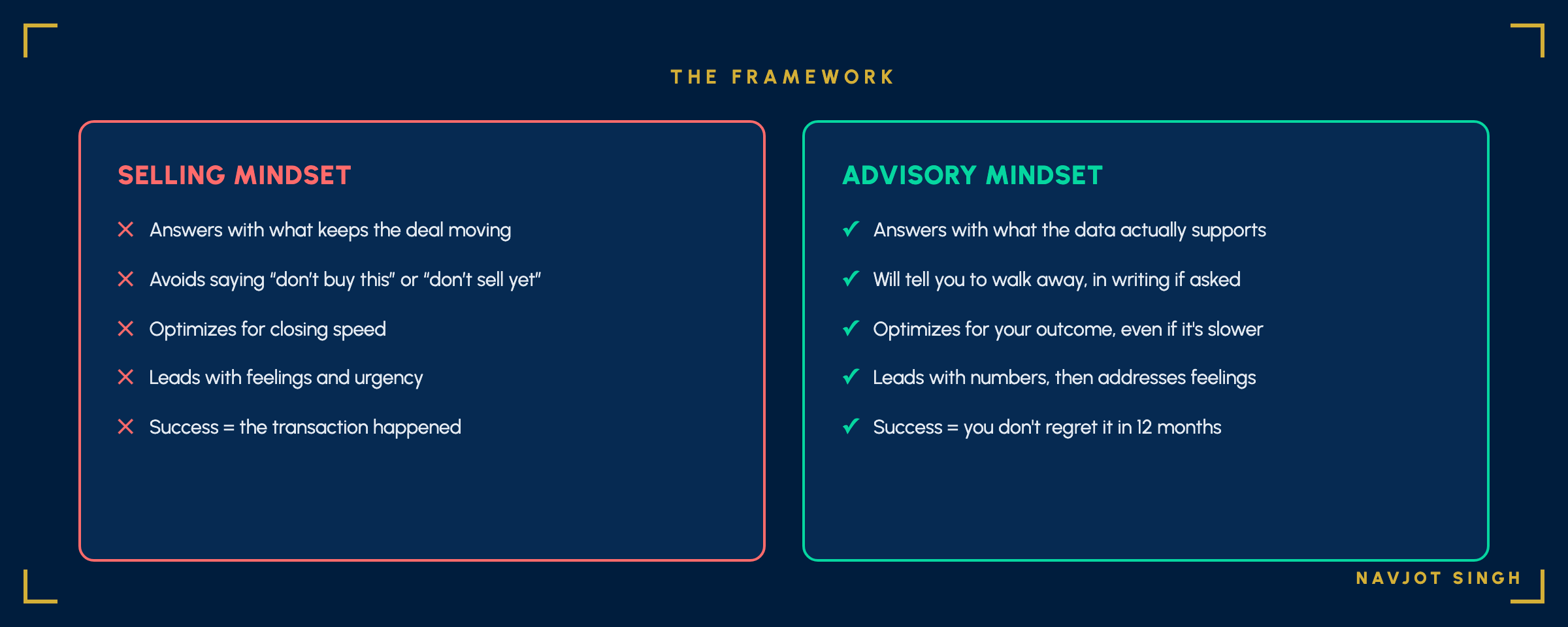
Most clients assume the agent's job is to help them buy or sell. That's incomplete. An advisory-mindset agent's job is to help you make the right decision — which sometimes means talking you out of the deal you walked in wanting. If your agent has never once told you not to do something, that's not proof you've made great decisions. It might just mean you've never been told the truth.
What the Survey Data Actually Shows (And Doesn't)
Be skeptical of any single "buyer regret" statistic, including ones that would support this piece's own argument. One 2025 survey found 37% of buyers reported no regrets, up from 31% in 2023. A different 2025 survey found 73% of homeowners expressed some regret about their purchase. Both can't be describing the same reality with the same precision — different methodologies, different samples, different questions asked. The honest takeaway isn't a number. It's that self-reported satisfaction is a weak signal, which is exactly why the questions below focus on process, not vibes.
The Questions That Actually Filter
Every standard "questions to ask a realtor" list — including the official ones published by NAR — asks about experience, market knowledge, and references. Those are competence questions. None of them diagnose which mindset you're actually hiring. These do.
- "Tell me about a deal where you advised a client to walk away." A selling-mindset agent will struggle to answer, or will describe a deal that fell apart for reasons outside their control. An advisory-mindset agent will have a specific story, with a specific reason, told without hesitation.
- "How does your compensation change based on the price I pay or the speed we close?" This is the fiduciary-duty disclosure question in plain language. A good agent explains the mechanics without flinching. A defensive answer is itself data.
- "If your recommendation and my instinct disagree, what happens?" Listen for whether they describe a process (data, comparables, a documented recommendation) or a relationship skill (talking you into alignment).
- "Will you put your recommendation against this specific property in writing, before I make an offer?" Verbal reassurance costs an agent nothing. A written recommendation creates accountability neither party can walk back from later.
Ask these before you ask about their marketing plan. The marketing plan only matters if you can already trust the person building it.
Where This Argument Has Limits
The Levitt/Syverson study is nearly two decades old and drawn from one metropolitan market; the underlying incentive mechanics are structural and durable, but the exact 3.7%/9.5-day figures shouldn't be treated as a universal constant across every market today. Dual-agency price-distortion research is genuinely mixed — some studies find measurable harm, at least one large sample found a statistically null average effect while still identifying offsetting winners and losers on each side of the deal. And plenty of individual agents operate with a strong advisory mindset despite a commission structure that doesn't reward it — incentives shape behavior on average, they don't determine any single person's integrity.
None of that changes the core claim. The structure rewards closing over correctness. The best agents resist that pull deliberately, on purpose, every time. That's worth being able to identify before you sign anything.
Frequently Asked Questions
Isn't this just an argument for flat-fee or discount brokerages?
Doesn't every professional who gets paid on commission have this same problem?
How do I ask "how does your compensation change" without the conversation getting awkward?
Does asking these questions really filter out serious agents, or just annoy them?
The Takeaway
The commission structure in real estate rewards a closed transaction. Nothing in that structure automatically rewards the right transaction, and reform efforts so far haven't changed that math. The fix isn't waiting for the industry to restructure itself. It's asking the four questions above before you sign anything, and paying closer attention to how an agent answers them than to how quickly they can get you into a showing.
If you want a second opinion on an agent's recommendation, or want to talk through a decision before you make an offer, reach out through navjotchahal.ca or contact Navjot Singh directly.
Recent Posts