
Ontario's NRST Rebate: A Bigger Signal Than the Buyer Ban
Policy Analysis
Ontario's NRST Rebate: A Bigger Signal Than the Buyer Ban
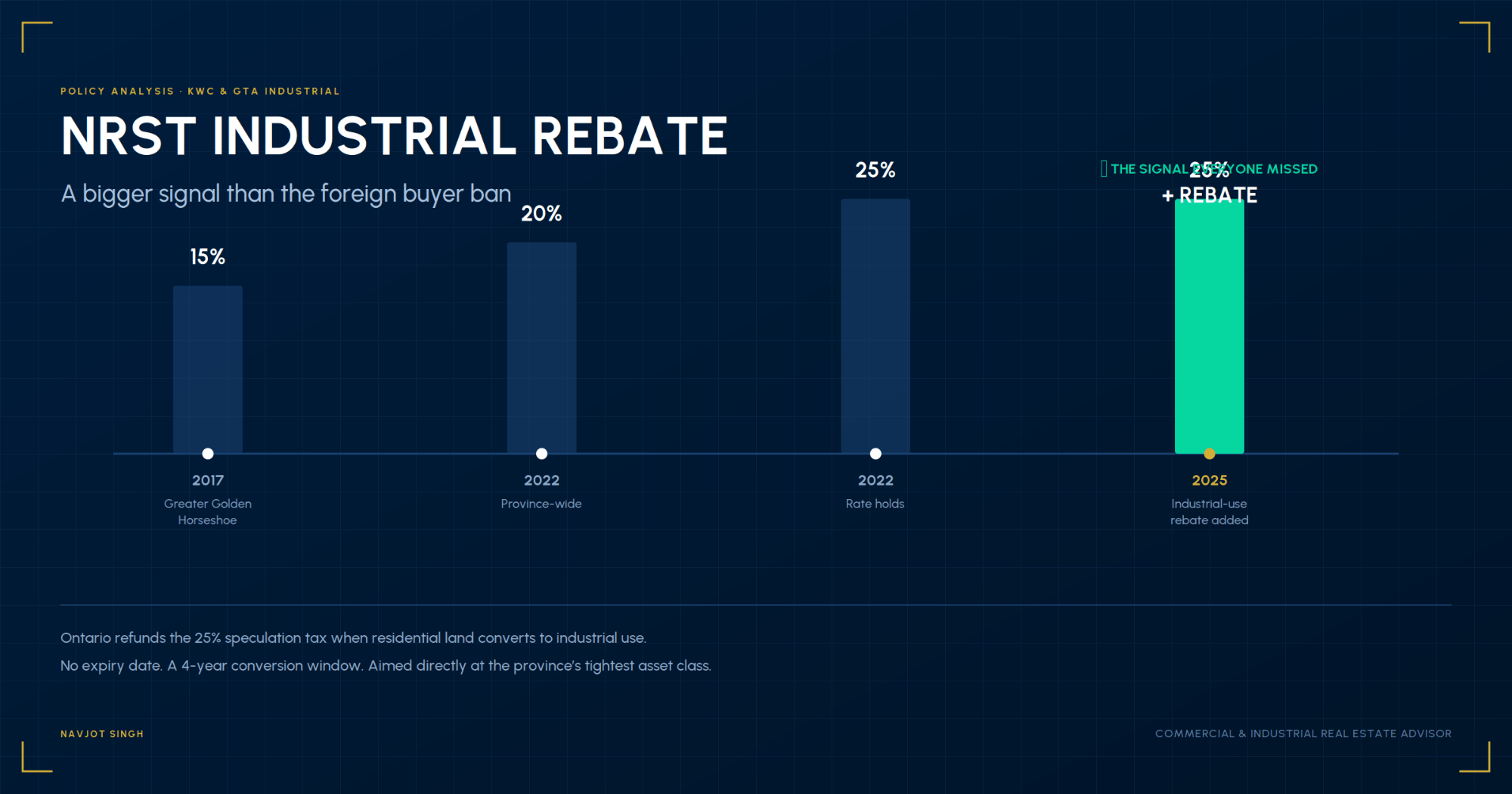
Ontario's Nov. 2025 NRST industrial-use rebate refunds the 25% speculation tax on land converted to industrial use — a bigger signal than the 2027 ban expiry.
By Navjot Singh, a residential and commercial/industrial realtor working with buyers and land holders across Kitchener-Waterloo-Cambridge and the Greater Toronto Area — including conversion-potential evaluations for residential-zoned land near industrial corridors.
Key Takeaways
- In November 2025, Ontario introduced an NRST rebate that refunds the 25% Non-Resident Speculation Tax when a residential property gets reclassified to industrial use within 4 years (Ontario Ministry of Finance, 2025).
- The federal foreign buyer ban expires January 1, 2027; the provincial NRST has no expiry date attached (Department of Finance Canada, 2024).
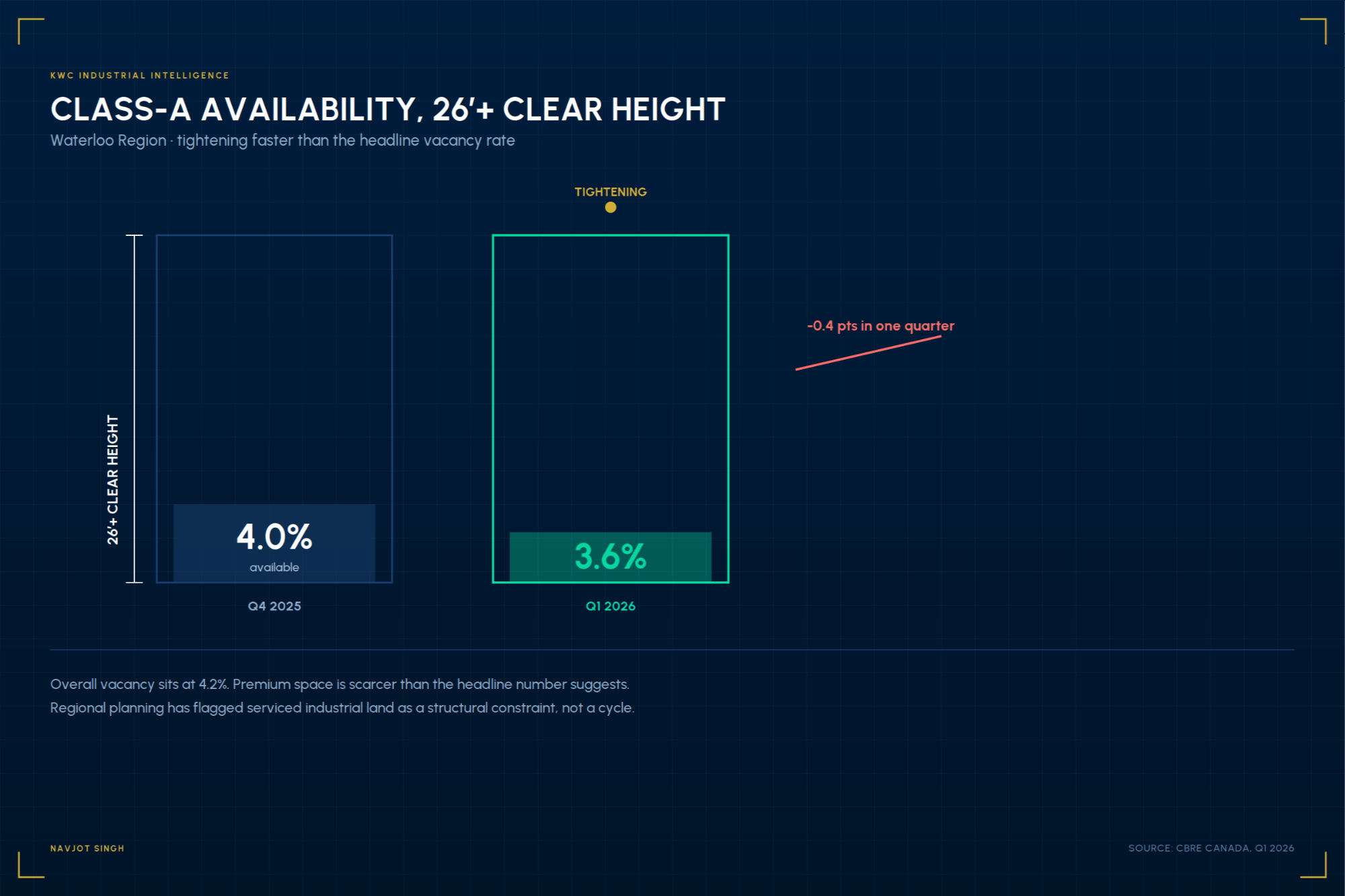
- Kitchener-Waterloo-Cambridge's premium industrial space (26'+ clear height) tightened from 4.0% to 3.6% availability in a single quarter, faster than the region's 4.2% headline vacancy rate suggests (CBRE Canada, Q1 2026).
- If you're holding residential-zoned land near an industrial corridor in KWC or the GTA, the rebate changes the conversion math — worth a conversation before assuming residential is still the highest use.
Everyone's watching the foreign buyer ban. In November 2025, Ontario made a quieter move that matters more if you're an industrial or commercial real estate investor — and almost nobody's talking about it.
Here's the outline most people already know. The federal ban on non-Canadians buying residential property expires January 1, 2027. Ontario's own 25% Non-Resident Speculation Tax (NRST) has no expiry date attached to it at all. Those two facts get discussed constantly. What doesn't get discussed: buried in the province's November 2025 fiscal update is a rebate that refunds the NRST when a residential property gets repurposed for industrial use. That's not a headline. It's a mechanism — and in a market like Kitchener-Waterloo-Cambridge, where usable industrial land is scarce, it's worth more of your attention than another ban headline.
The Ban and the Tax Everyone Already Knows About
Canada's foreign buyer ban and Ontario's NRST are two different tools, and conflating them is where most of the confusion starts. As of 2026, the federal Prohibition on the Purchase of Residential Property by Non-Canadians Act is set to expire January 1, 2027, after Ottawa extended it by two years in 2024 (Department of Finance Canada, 2024). It restricts non-Canadians from buying residential property outright, with carve-outs — including an exemption for purchases made for development purposes (CMHC, 2026).
The NRST is Ontario's own instrument, and it works differently: it's a 25% tax added at closing when a non-resident buys residential property, in force province-wide since October 2022 with no sunset clause written into it (Ontario Ministry of Finance, 2026). Toronto layers on an additional 10% Municipal NRST on top, which took effect in January 2025 — meaning a non-resident buyer in the City of Toronto can face up to 35% combined, while the same buyer in Kitchener-Waterloo-Cambridge faces the 25% provincial rate alone. That gap matters more than it sounds like it should, and I'll come back to it.
Here's what almost nobody covering these two policies has connected: while the federal ban is a countdown clock, the NRST rebate Ontario quietly added in November 2025 is a permanent new exit ramp — and it points straight at industrial land.
Why the NRST Industrial Rebate Is the Bigger Story
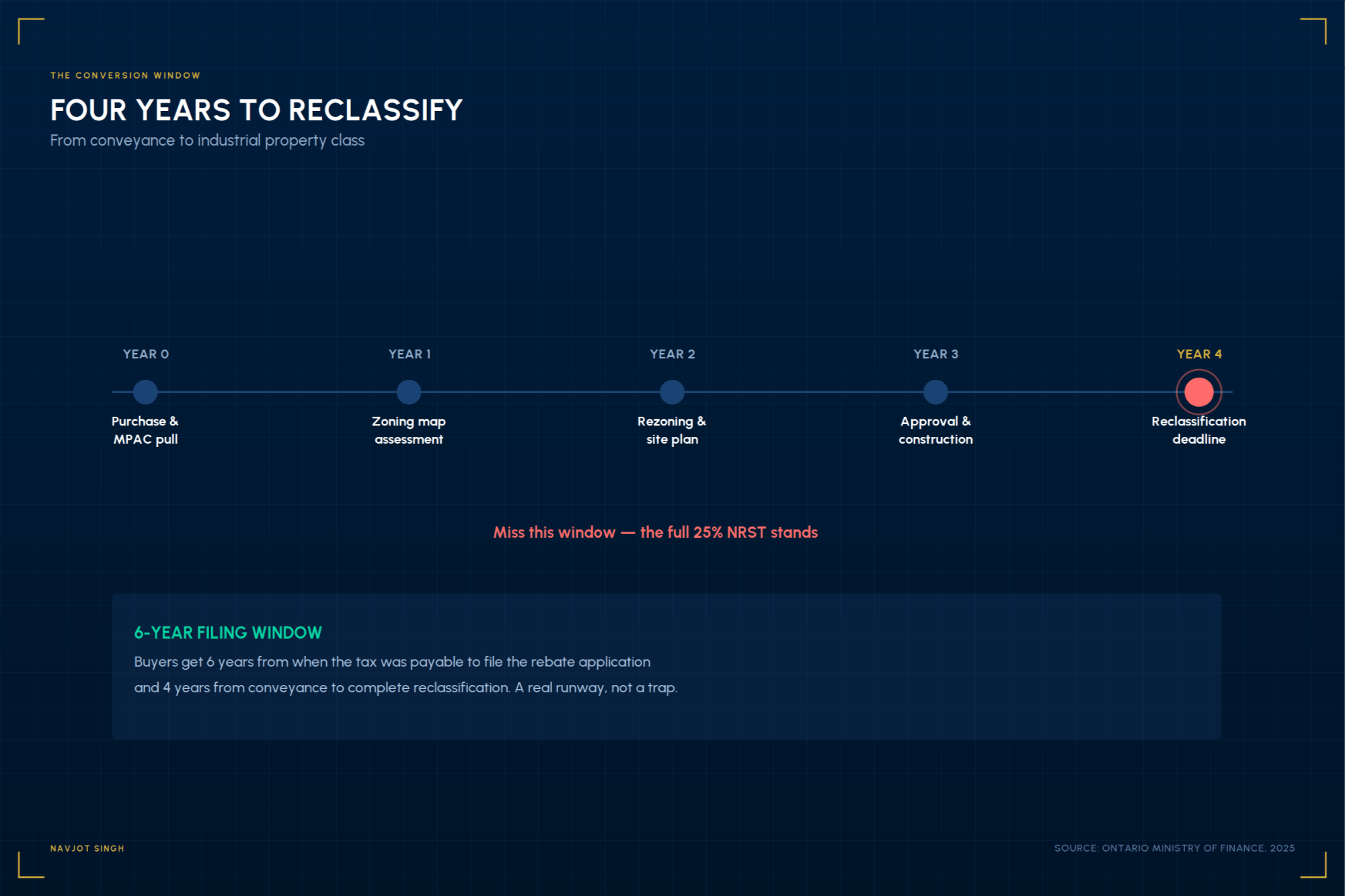
Ontario's industrial-use rebate refunds the NRST a buyer paid if the property is reclassified into an industrial property class under the Assessment Act within 4 years of the purchase (Ontario Ministry of Finance, 2025). Introduced through the 2025 Ontario Economic Outlook and Fiscal Review on November 6, 2025, it's since been independently confirmed by two national tax advisory firms as a genuine amendment to the Land Transfer Tax Act regulation (KPMG Canada, 2025; McCarthy Tétrault, 2025).
How the Rebate Works
Isn't this just a minor tax carve-out? No — read the mechanics closely and it's a deliberate incentive, not a loophole. Three details make that clear.
It targets a specific outcome, not a specific buyer. The rebate applies when a property gets reclassified into the Industrial Property Class, Large Industrial Property Class, or Aggregate Extraction Property Class. Ontario isn't rewarding non-resident ownership — it's rewarding a land-use outcome. Convert the whole property and the province refunds the full NRST; convert only part of it and Ontario apportions the rebate by assessed-value ratio between the residential and industrial use (Ontario Ministry of Finance, 2025).
It's built to be usable, not symbolic. Buyers get 6 years from the date the tax was payable to file the rebate application, and 4 years from the conveyance date to complete the reclassification. That's a real runway for site plan approval, rezoning, and construction, not a narrow window designed to expire unused.
The Rebate in Real Numbers
Run the math on a typical parcel and the incentive gets concrete fast. A non-resident buyer who pays $375,000 in NRST on a $1.5 million residential-zoned parcel — 25% of the purchase price — recovers that full $375,000 once the property is reclassified to an industrial property class within the 4-year window.
Ontario doesn't keep that money if the conversion happens; it hands it back. That's what separates an incentive from a tax.
Nobody writing about NRST connects it to land economics. In researching this, I found plenty of tax-practitioner summaries of the rebate and plenty of general "NRST explained" guides for residential buyers. None of them connect the rebate to industrial land scarcity or frame it as an investment signal — which is exactly why the ban headline is drowning out the mechanism that matters more.
Put those three details together and the rebate reads less like a tax adjustment and more like the province using its own speculation tax as an incentive lever — nudging capital that already landed in residential toward the asset class that's structurally undersupplied. The foreign buyer ban is a blunt restriction with a countdown clock. This rebate is a precision tool with no expiry, and it's aimed directly at industrial conversion.
What the Data Shows: KWC and GTA Are Both Starving for Industrial Land
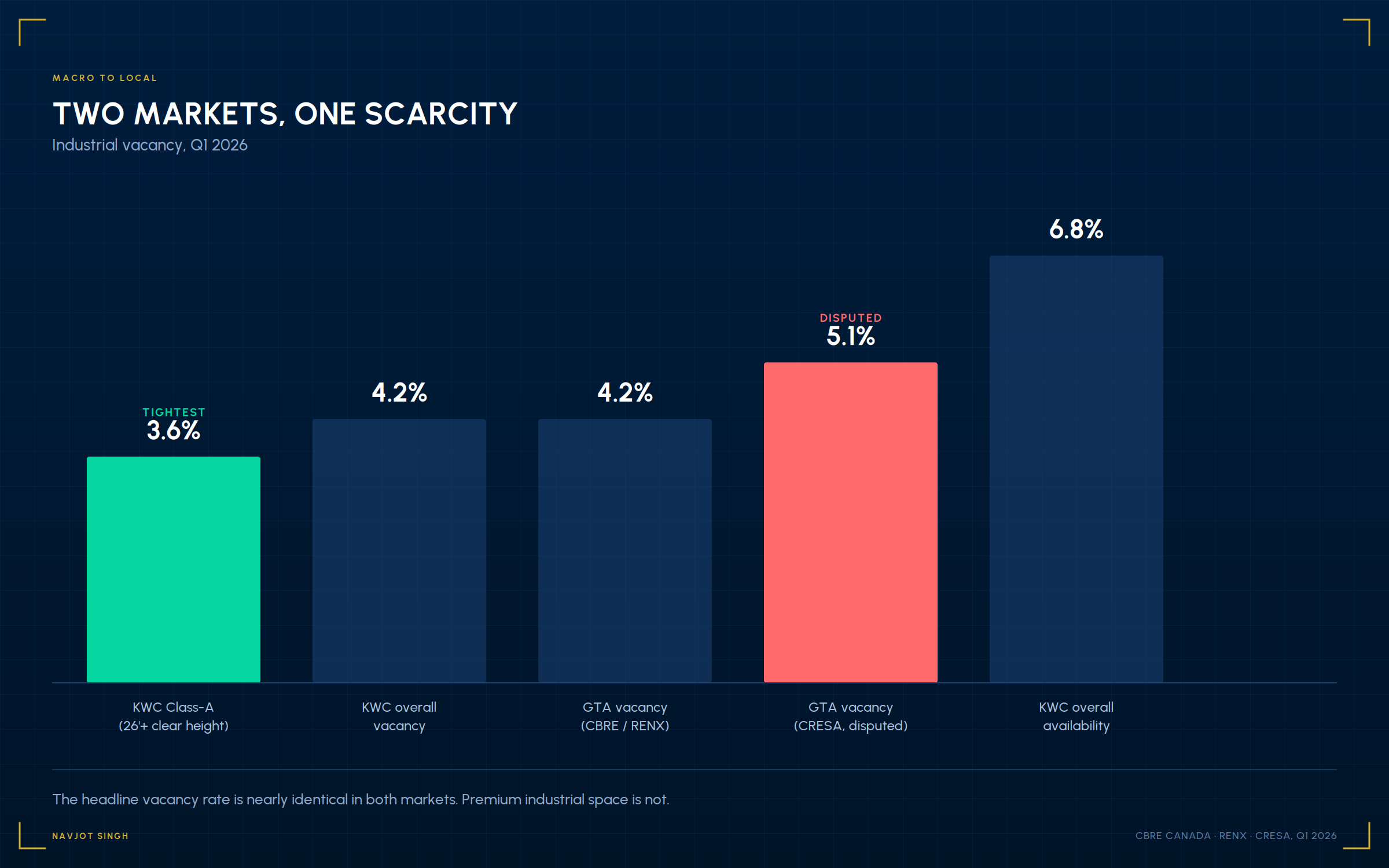
Vacancy sits at roughly 4.2% in both Kitchener-Waterloo-Cambridge and the GTA as of Q1 2026 — but the headline number hides how much tighter each market really is beneath the surface (CBRE Canada, Q1 2026; RENX, May 2026). If you're only tracking the topline vacancy rate, you're missing where the real scarcity is concentrated.
KWC: Scarcity Beneath the Headline Number
In Waterloo Region, overall industrial vacancy held at 4.2% in Q1 2026 with 6.8% availability — but that average masks a sharper story in premium space. Availability of Class-A industrial space with clear heights above 26 feet — the kind modern logistics and manufacturing tenants actually want — tightened from 4.0% to 3.6% in a single quarter (CBRE Canada, Q1 2026). Regional economic development planning has flagged a shortage of serviced industrial land as a structural constraint on the region's growth, not a cyclical blip (Waterloo Region Economic Development Strategy, PDF, 2025, retrieved 2026-07-20).
GTA: Tight at Greater Scale
The GTA tells a parallel story at greater scale. Vacancy eased slightly from 4.5% in Q4 2025 to 4.2% in Q1 2026, described by industry analysts as "the floor is in" rather than a genuine loosening — extremely tight development land supply remains the unchanged fundamental, driven by proximity to more than 15 million consumers (RENX, citing Lennard Commercial Realty, May 2026).
One brokerage's Q1 2026 GTA Industrial Market Report, from CRESA, puts the figure higher still — as high as 5.1%, an 11-year high by that firm's methodology. No direct link to that report was available for citation here, so treat it as a secondary data point rather than a verified consensus number; vacancy and availability also get measured differently across brokerages, which explains part of the spread.
| Market | Metric | Q4 2025 | Q1 2026 | Source |
|---|---|---|---|---|
| KWC (Waterloo Region) | Overall industrial vacancy | — | 4.2% | CBRE Canada, Q1 2026 |
| KWC (Waterloo Region) | Overall industrial availability | — | 6.8% | CBRE Canada, Q1 2026 |
| KWC (Waterloo Region) | Class-A (26'+ clear height) availability | 4.0% | 3.6% | CBRE Canada, Q1 2026 |
| GTA | Industrial vacancy (CBRE/RENX) | 4.5% | 4.2% | RENX, May 2026 |
| GTA | Industrial vacancy (CRESA, disputed) | — | 5.1% | CRESA GTA Industrial Market Report, Q1 2026 |
Where This Actually Applies: Residential Land Near Industrial Corridors
This isn't a story about buying a warehouse. It's a story about land that's currently zoned residential but sits close enough to an industrial corridor that reclassification is realistic — think parcels adjacent to existing industrial parks, along rail spurs, or near highway interchanges in growth areas of KWC and the GTA's outer ring. That's the specific asset type this rebate was built for, and it's exactly the kind of holding a residential investor might not think to re-evaluate.
Who This Matters To — And What to Do About It
If you own residential-zoned land near an industrial corridor in KWC or the GTA, this rebate changes your math — but the two markets call for different starting questions. In KWC, the constraint is land scarcity itself: with serviced industrial land already flagged as a regional bottleneck, converting even a modest residential parcel can meet real, underserved demand.
In the GTA, the constraint is closer to price and permitting complexity — land costs more and rezoning draws more contest. But the rebate pays out more in absolute dollars in Toronto specifically, where the 35% combined NRST/MNRST rate makes a full refund substantially larger than the 25% rebate available in KWC.
In conversations with clients holding residential-zoned parcels near industrial areas, the question almost never comes up unprompted — most assume the current zoning is the ceiling on value rather than a starting point for a rezoning conversation. That assumption is exactly what this rebate should change.
Three things are worth doing before you assume your land's highest use is still residential:
- Start with your MPAC assessment. Pull your property's current classification — you can't evaluate a path to Industrial Property Class without knowing your starting point.
- Map the parcel against what's already around it. How close is it to an active industrial corridor, a rail spur, or a highway interchange? Proximity is most of what determines whether reclassification inside the 4-year window is realistic or wishful thinking, and it's a five-minute check against a municipal zoning map.
- Model the apportionment math before ruling anything out. A partial conversion still captures a partial rebate.
Holding residential-zoned land near an industrial corridor in KWC or the GTA? Reach out through navjotchahal.ca to talk through your parcel's conversion potential.
Where This Argument Could Be Wrong
The biggest caveat: qualifying for this rebate requires an actual completed reclassification, not just an intention to convert. If rezoning, site plan approval, or environmental assessment stalls past the 4-year window, the rebate isn't available and the full NRST stands. Municipal approval timelines in both KWC and the GTA can easily exceed four years for contested sites, so this only works as a strategy if the reclassification path is genuinely realistic before you commit — not a fallback if the numbers don't otherwise work.
It's also worth being honest that the conventional read isn't wrong, just incomplete: the foreign buyer ban's 2027 expiry is a legitimate signal too, since it could reopen non-resident residential demand in ways that affect land values broadly. The rebate doesn't replace that analysis — it adds a second, quieter signal that most investors are currently missing entirely. And the GTA's disputed vacancy figures mean the case for scarcity there is directionally strong but numerically less precise than in KWC, where the data is more consistent across sources.
Frequently Asked Questions
Does the NRST industrial-use rebate apply retroactively to NRST already paid before November 2025?
Yes — the rebate applies to NRST paid on any qualifying conveyance, provided the reclassification to an industrial property class happens within 4 years of that conveyance and you file the rebate application within 6 years of when the tax became payable (Ontario Ministry of Finance, 2025). It doesn't matter whether you purchased before or after the rebate itself was announced.
What if I only convert part of my residential-zoned property to industrial use?
You still get a rebate, apportioned by the assessed-value ratio between the residential and industrial portions of the property after reclassification (Ontario Ministry of Finance, 2025). A partial conversion is a legitimate strategy if full industrial reclassification isn't realistic for your site.
Is it better to just wait for the foreign buyer ban to expire in 2027 instead?
Those aren't competing strategies — the ban affects future non-resident residential purchases, while the rebate addresses land you already hold. In tight industrial markets like KWC, waiting on a federal policy with an uncertain renewal outlook means missing years of use from land that could be converted now.
Does the rebate apply to Toronto's additional 10% Municipal NRST, or only the provincial 25% rate?
The confirmed sources describe the rebate against the provincial NRST specifically; whether it extends to Toronto's stacked Municipal NRST isn't clearly documented in the primary sources reviewed for this piece. If you're evaluating a Toronto property, confirm this directly with a tax advisor before modeling the full 35% as recoverable.
The Headline Isn't the Signal
The foreign buyer ban will keep generating headlines until it expires or gets extended again in 2027. Ontario's NRST industrial-use rebate won't generate headlines at all — it's a mechanism, not a policy announcement, and mechanisms don't trend. But if you're holding residential-zoned land near an industrial corridor in Kitchener-Waterloo-Cambridge or the GTA, this rebate is the more actionable signal of the two, and it isn't going anywhere.
If that describes land you're holding, it's worth a conversation about whether residential is still its highest use before you assume the answer. I work with both residential and commercial/industrial clients across KWC and the GTA — reach out through navjotchahal.ca or contact Navjot Singh directly to talk through your specific parcel's conversion potential.
Recent Posts