
Trade Policy, Manufacturing Economics, and Commercial Real Estate: Why Ontario's Industrial Bet Is More Important Than Your Cap Rate
Trade Policy, Manufacturing Economics, and Commercial Real Estate: Why Ontario's Industrial Bet Is More Important Than Your Cap Rate
Most business owners and commercial investors treat tariff announcements like weather. They notice. They react. Then they move on.
This is how you destroy capital in illiquid assets.
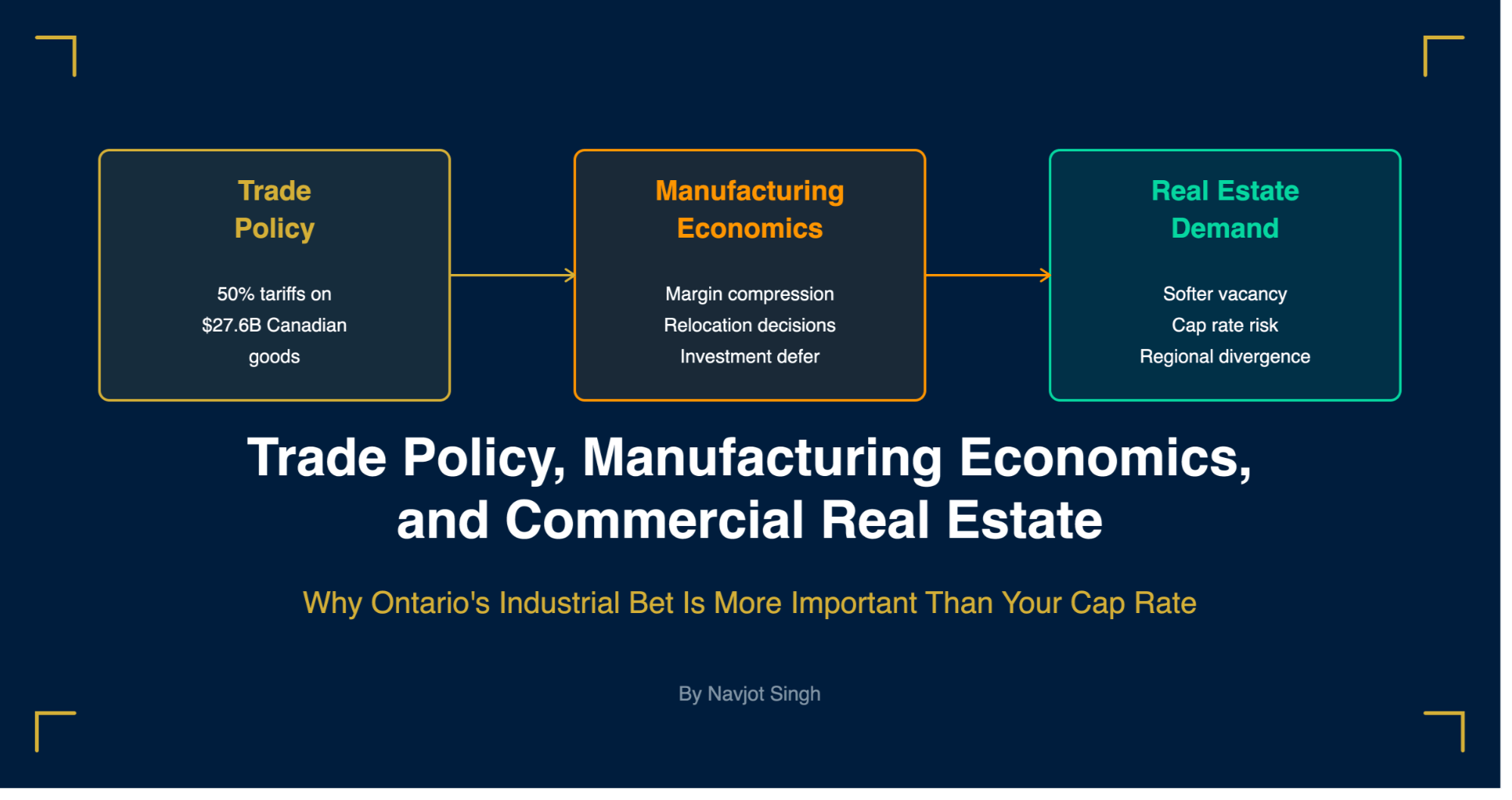
Here's the problem: tariff policy doesn't directly affect commercial real estate. It affects what happens to manufacturing economics, which affects location decisions, which affects real estate demand. When you can't see that chain, you make decisions based on cap rates instead of on the system that generates those cap rates.
In a stable environment, that's a mistake. In an uncertain environment, it's a disaster.
Since August 2026, the US and Canada have been in full tariff escalation. The US imposed 50% tariffs on $27.6 billion of Canadian goods. Canada matched it dollar-for-dollar effective September 8. Negotiations collapsed. Nothing is settled.
If you own or are considering commercial or industrial real estate in Ontario—especially in Southwestern Ontario—you need to understand what this means for your capital. Not the headlines. The system.
This article is general market education on how tariff policy affects manufacturing economics and real estate markets. It is not personalized investment advice. All real estate and capital allocation decisions should be made with a qualified advisor who understands your specific tenant base, regional exposure, and risk tolerance.
The System: From Trade Policy to Commercial Real Estate Value
Let me lay this out.
Trade policy shapes manufacturing economics.
When tariffs rise 50% on a cross-border supply chain, manufacturers face a simplified choice tree:
- Absorb the cost (margins compress)
- Raise prices (if customers will accept it)
- Relocate production (if the capex math works)
- Automate faster (if technology exists)
- Reduce scale (if demand is elastic)
Each of these decisions has a different implication for real estate demand.
Manufacturing economics drive location decisions.
A US manufacturer facing new tariffs on Canadian inputs evaluates: Do I source from Canada at higher tariff cost? Do I build capacity in Canada to avoid the tariff? Do I consolidate production and shrink my footprint?
A Canadian manufacturer exporting into the US under a new 50% tariff asks: Can I stay price-competitive? Can I relocate key production to the US? Should I accelerate efficiency investments to offset margin compression?
Location decisions drive commercial real estate demand.
If a region's manufacturing base is growing (because tariff policy favors it), industrial space demand rises. Rents rise. Cap rates compress. Vacancy falls. Landlord leverage increases.
If a region's manufacturing base is shrinking or deferring investment (because tariff policy makes them uncompetitive), industrial space demand softens. Rents flatten or decline. Cap rates expand. Vacancy rises. Landlord pricing power falls.
This does not happen uniformly across Ontario.
Different regions have different industrial compositions. Different compositions mean different tariff exposure. Different exposure means different outcomes.
Why Ontario's Geographic Bet Matters
Ontario's manufacturing is not evenly distributed. The concentration matters.
Southwestern Ontario (Kitchener-Waterloo-Cambridge, Hamilton, London, Windsor):
Motor vehicle parts, primary metals (steel and aluminum), and machinery represent the largest employment concentration in the region, according to Ontario's Financial Accountability Office. These are exactly the sectors tariff policy targets.
Greater Toronto Area (Toronto, Brampton, Oshawa, Ajax):
Also has significant automotive and parts manufacturing. More diversified. But still concentrated in tariff-exposed sectors.
Why this matters:
If you're investing industrial real estate in KWC, you're making a bet on how tariff policy affects automotive parts suppliers, steel processors, and machinery manufacturers. That's not background risk. That's your primary risk.
Southwestern Ontario industrial availability rose to 7.2% in Q1 2026—the only major regional segment where vacancy increased year-over-year. While the rest of Canada's industrial markets tightened, KWC got looser. The market is signaling something is off here.
The Evidence: What the Data Actually Says
Employment exposure is real and quantified.
The Financial Accountability Office of Ontario projects that Kitchener-Cambridge-Waterloo employment will be 1.5% lower in 2026 compared to a no-tariff scenario. Windsor faces 1.6% lower employment. Other Southwestern Ontario regions—Guelph, Brantford, London—face 1.3% to 1.6% employment headwinds.
That's not trivial noise. That's structural employment loss in your tenant base.
Sectoral impact is uneven and severe.
Motor vehicle parts is the most impacted manufacturing sector, with real GDP 22.3% lower than in a no-tariff scenario. Primary metals (steel, aluminum) faces 18.2% GDP decline. Motor vehicle manufacturing faces 12.3% decline. Machinery and electronics faces 7.6% decline.
If your industrial park houses automotive parts suppliers or steel fabricators, you're not hedging a 2-3% economic headwind. You're facing the prospect of tenant margin compression of 12-22%.
Real estate markets are already pricing risk differently by region.
Toronto Class A industrial cap rates stood at 5.00-5.25% in Q4 2025. Kitchener-Waterloo Class B industrial was 6.00-7.00%.
This gap is not random. The market is already saying: KWC industrial carries more risk than Toronto industrial. The gap is reflecting tariff exposure.
What "Tariffs Start September 8" Actually Means
On September 8, 2026, Canada's retaliatory tariffs took effect. Canada imposed 15%, 25%, and 50% tariffs on over 700 products drawn from those targeted by US Section 338 and Section 232 tariffs, covering $27.6 billion in US imports.
The sectors hit are concrete: steel and aluminum, dairy, appliances, agricultural equipment, pulp and paper, plastics, and electronics.
If you're a landlord to a manufacturer of agricultural equipment in Southwestern Ontario, your tenant's input costs (steel, aluminum) just spiked. If they also export product into the US, they face a 50% tariff on outbound goods.
That's not a 2% margin compression. That can be an existential margin problem.
The Real Estate Implication: Why Your Cap Rate May Not Protect You
Here's where most investors get stuck.
You look at a KWC industrial property. You see a 6.5% cap rate. You compare it to a Toronto property at 5.0-5.25%.
You think: The KWC property is cheaper (higher cap rate). So I get more income per dollar invested. Good deal.
But you're missing the system.
The higher cap rate isn't free income. It's compensation for risk. And the risk is structural:
Tenant revenue is tariff-dependent. Your tenants—automotive parts suppliers, steel processors, machinery makers—generate significant revenue from cross-border supply chains or export markets. Tariff policy directly affects their top line.
Margin compression is real. FAO data suggests 12-22% GDP decline in your tenant sectors. That translates to serious margin pressure. A 6.5% cap rate assumes NOI stability. If your tenant's margin compresses 15%, your actual return is not 6.5%. It's much lower.
Refinancing risk is high. If your tenant's credit quality deteriorates, refinancing becomes harder and more expensive. Your cap rate is based on current financing costs. If spreads widen because of tenant risk, your actual return is again lower.
Geographic concentration kills diversification. If 60% of KWC industrial park tenants are in automotive parts or steel, you're not diversified. You're concentrated. That concentration is already reflected in a 125 bps cap rate premium over Toronto. Is it enough? Probably not.
Ontario manufacturing employment increased by 0.4% in Q2 2026 compared with a year earlier—the weakest quarterly growth of the cycle. This is deceleration before collapse. Businesses are deferring expansion. They're waiting to see if tariff policy stabilizes. This is the leading indicator that matters.
Three Scenarios for the Next 12-18 Months
You can't predict tariff policy. But you can map the scenarios and their real estate implications.
Scenario 1: Tariffs stabilize at current levels.
Manufacturers adjust. They find the margin compression tolerable. They optimize operations but don't relocate. They invest in efficiency, not expansion.
Real estate outcome: Industrial demand stabilizes at lower levels. Rents flatten. Vacancy holds above historical norms. Cap rates stay elevated because ongoing uncertainty persists. Tenants negotiate harder. Some smaller suppliers fail.
KWC outcome: Industrial cap rates remain elevated. Growth stalls. Investors pause deployment. Properties trade at higher yields but with lower asset value appreciation. Landlords focus on tenant credit quality as downside protection.
Scenario 2: Tariffs soften through negotiation.
US and Canada reach a deal. Tariff levels decline. Uncertainty falls. Business capital returns. Manufacturers resume expansion plans. Cross-border supply chains stabilize.
Real estate outcome: Industrial demand accelerates. Rents rise. Vacancy falls. Cap rates compress. Landlord pricing power increases. Asset values appreciate.
KWC outcome: Industrial market tightens. Cap rates compress toward Toronto levels (or beyond, if catch-up is sharp). Landlords with available space can raise rents. New investment flows into the region.
Scenario 3: Tariffs escalate further.
Trade tensions worsen. New tariffs announced. Manufacturing contracts. Some companies relocate. Supply chains fragment.
Real estate outcome: Industrial demand softens. Rents decline. Vacancy rises. Cap rates expand significantly. Some landlords face refinancing pressure. Distressed sales increase. Tenant failures accelerate.
KWC outcome: Industrial market weakens. Cap rates expand beyond current levels. Investor capital leaves the region. Properties that seemed safe at 6.5% caps face refinancing risk at 8% caps. Margin calls on leveraged deals.
The question for you: Which scenario is most likely? That's where your analysis should start. Not "What cap rate should I accept?" but "Which scenario is most likely, and what does it mean for my tenant, my region, and my capital?"
How to Analyze Your Own Exposure
If you're a business owner considering expansion or relocation:
Map your input exposure. What percentage of your inputs are subject to tariffs? If tariffs rise 25-50%, what happens to your cost of goods sold?
Map your customer exposure. Do your customers export? Are they in tariff-protected or tariff-exposed sectors? If their demand declines, does your revenue decline proportionally?
Assess your location bet. If you're considering real estate in a concentrated manufacturing region (KWC, Hamilton, Windsor), you're betting that tariff policy improves or stabilizes. What's your confidence level in that bet?
Consider the timing. The data shows deferred decision-making. Businesses waiting. Expansion plans on hold. This suggests a 12-18 month deferral window. Can you afford to wait?
If you're a landlord or investor:
Understand your tenant's supply chain. Where does your tenant source inputs? Where do they sell output? How much is tariff-exposed?
Stress-test the financials. If your tenant's costs rise 15% and they can't pass it through to customers, what happens to NOI? Can they absorb it? For how long?
Price the risk properly. A 6.5% cap rate in a tariff-exposed region might feel like good income. But if it's compensating you for 15-25% downside risk, is it actually a good deal? Would you prefer a 5% cap rate with lower risk?
Build in liquidity. If tariff policy turns for the worse, can you sell? Or are you forced to hold and refinance at higher spreads?
The Principle: Why Systems Matter More Than Cap Rates
Most commercial real estate analysis focuses on spreadsheets: cap rates, NOI projections, rent growth assumptions.
But a spreadsheet can't capture a system change.
When tariff policy shifts, it doesn't just tweak the numbers. It reshapes the entire system that generates those numbers. Manufacturing economics change. Location decisions change. Tenant demand changes. Real estate demand changes.
A 6.5% cap rate assumes that your tenant's business model remains intact. But if tariff policy makes that business model uncompetitive, the cap rate is a mirage.
This is why understanding the system matters. When you understand how trade policy drives manufacturing decisions, which drive location decisions, which drive real estate demand, you can see what the spreadsheet can't: which locations are bet-safe and which are bet-dependent.
Frequently Asked Questions
How do I know if my tenant is tariff-exposed?
Is a higher cap rate always worth the tariff risk in KWC?
What's the difference between Toronto and KWC industrial from a tariff perspective?
Should I defer all expansion decisions until tariffs settle?
Can I refinance my industrial property if tariff policy worsens?
What to Do Now
First: Stop treating tariff policy as noise. It's a leading indicator for your tenant base.
Second: Understand your regional exposure. If you're investing in KWC, Hamilton, or Windsor industrial real estate, you're making a concentrated bet on manufacturing. That's fine. But know it.
Third: Size your capital to the uncertainty. If tariff policy is uncertain for 12-18 months, don't deploy your full capital today. Stage it. Let the signal clarify.
Fourth: Price risk properly. A higher cap rate is not free money. It's compensation for risk. Make sure the compensation matches the risk you're taking.
Fifth: Monitor the real signals. Not cap rates (lagging). Not headlines (noise). Manufacturing employment trends. Tenant capital expenditure plans. Sectoral vacancy rates. Business confidence surveys. These are the signals that matter.
A Final Thought
Ontario's commercial real estate market in the next 2-3 years will diverge significantly based on geographic concentration and sectoral composition.
Toronto and diversified markets will outperform concentrated industrial regions.
Within concentrated regions, landlords with strong tenant credit quality will outperform landlords with tariff-exposed tenant bases.
Within tenant bases, companies with insulated revenue sources will outperform companies dependent on cross-border supply chains.
This is not a prediction. This is a systems-based probability assessment.
Investors who understand this will make better decisions than investors who don't.
The question is: Do you?
Recent Posts