
Should Your Down Payment Sit in Cash, or Go to Work?
Should Your Down Payment Sit in Cash, or Go to Work?
Here's a scenario I get asked about constantly: someone can save $4,000 a month toward a down payment and wants to know if they should just let it sit in cash, or invest it, to reach $100,000. The generic content on this question always says the same thing — invest it, growth compounds, look at this smooth exponential curve. Run the actual math on a 24-month horizon and the picture is more interesting, and more useful, than that.
This is general education on how these accounts and this math work, not a personalized investment recommendation. Pair this with a licensed financial advisor for your specific mix — I can help you translate whatever number you land on into what it actually buys you in today's market.
All figures cited in this article have been verified by Akshita Puri, Financial Advisor, against current CRA rules, Bank of Canada policy rates, and published financial data as of 2026. FHSA limits, TFSA contribution room, RRSP Home Buyers' Plan rules, and J.P. Morgan Asset Management return data are all current and accurate as stated.

Akshita Puri
416-880-0023 | akshatapuri5@gmail.com
Wealth Protection Professional
[LLQP licensed]
Financial analysis and scenario modeling for this article. Expertise in down payment strategy, FHSA/TFSA/RRSP planning, and financial goal mapping.
The Account and the Investment Are Two Separate Decisions
Before comparing cash to investing, clear up the single most common confusion: FHSA, TFSA, and RRSP are tax wrappers, not investments. Each one is a container the CRA gives special tax treatment to. What you hold inside it — cash, a GIC, an ETF, a savings account — is a completely separate decision, and it's the one that actually determines your return. Parking cash in a TFSA and never investing it earns you exactly what parking cash anywhere else earns you: whatever interest rate applies, and no more.
The Three Accounts, Compared
| Account | Contribution Limit | Tax In | Tax Out (Home Purchase) | Best For |
|---|---|---|---|---|
| FHSA | $8,000/year, $40,000 lifetime | Deductible, like an RRSP | Tax-free, like a TFSA | First-time buyers — the only account built specifically for this goal |
| TFSA | $7,000/year (2026); $109,000 lifetime room if eligible since 2009 | Not deductible | Always tax-free, for any purpose | Flexibility — use it for the home or anything else, no restrictions |
| RRSP (Home Buyers' Plan) | Withdraw up to $60,000 per person ($120,000 per qualifying couple) | Deductible when contributed | Tax-free if withdrawn under HBP rules | Buyers who already have RRSP savings and can repay over 15 years |
The FHSA is the standout for a first-time buyer specifically: it's the only account that gives you a tax deduction going in and a tax-free withdrawal coming out, provided the money goes toward a qualifying home purchase. If you don't end up buying, FHSA funds can transfer tax-deferred into an RRSP without using up RRSP room — you don't lose the money, you just lose the double tax benefit.
The RRSP Home Buyers' Plan is worth knowing about even if retirement feels far away: the withdrawal limit was raised from $35,000 to $60,000 per person for withdrawals made after April 16, 2024, and a qualifying couple can combine two limits for $120,000 toward one purchase. The tradeoff is real, though — it's a loan from your own retirement, and you must repay 1/15th of it each year starting the second year after withdrawal, or the missed portion becomes taxable income that year.
The Question Everyone Asks Wrong
Most people frame this as "should I invest my down payment." That's the wrong first question. The right first question is: how much time do I actually have? The answer changes everything downstream, because return and risk both scale with time, and a 24-month house-buying timeline is not long enough to treat like a 20-year retirement timeline.
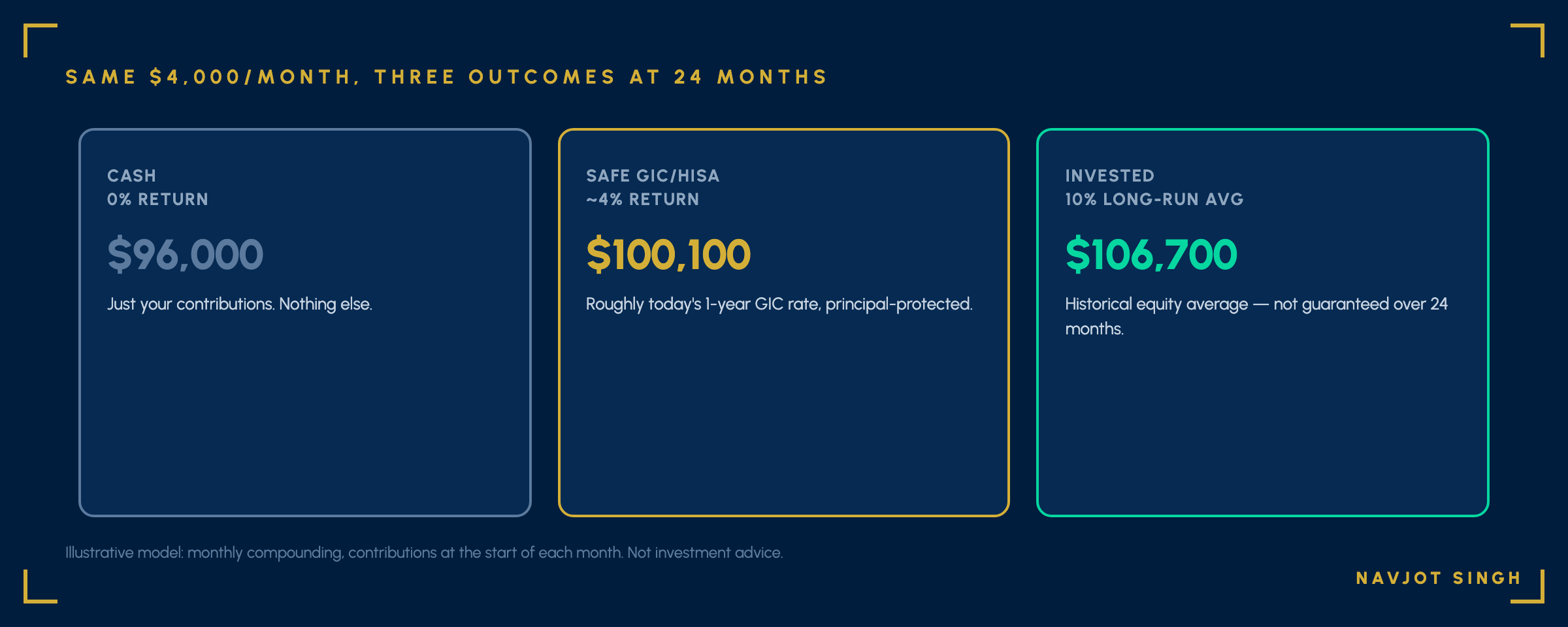
Take the $4,000-a-month, $100,000-goal scenario and run three honest versions of it: cash earning nothing, a safe GIC or high-interest savings account earning close to today's rate, and a fully invested portfolio earning the long-run historical stock market average.
Now look at the same three scenarios measured by time instead of by ending balance — how long each one actually takes to cross $100,000.
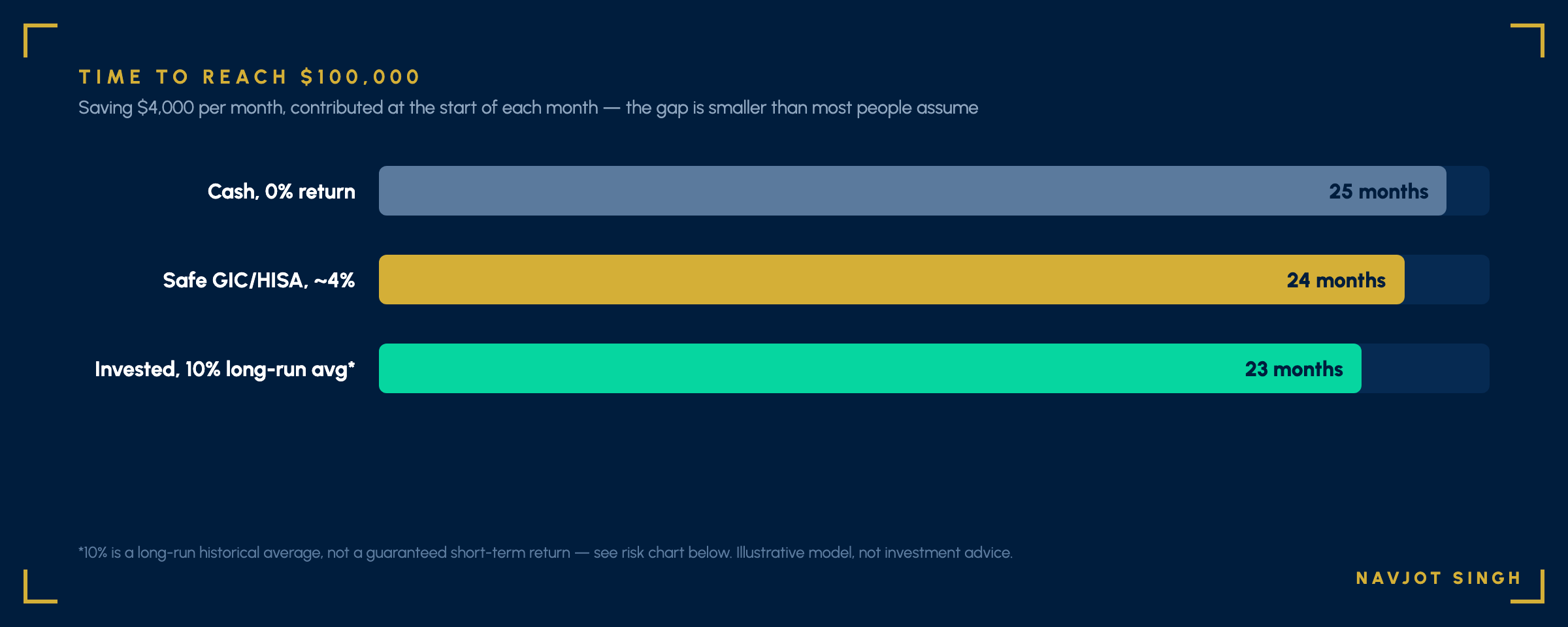
Chasing the higher long-run return only bought two months. Most people assume investing is the difference between "eventually" and "soon." Over a 24-month horizon funded by a large, consistent monthly contribution, it's the difference between month 25 and month 23 — and that gap comes with the risk described next.
The 10% Is an Average, Not a Promise
Every generic version of this comparison uses a single clean growth rate and draws a smooth curve. Real markets don't move in smooth curves. J.P. Morgan Asset Management's own research shows that rolling 1-year U.S. stock market returns from 1950 through mid-2024 have ranged from -41% to +60%, averaging 12.5%. The average is real. So is the range around it.
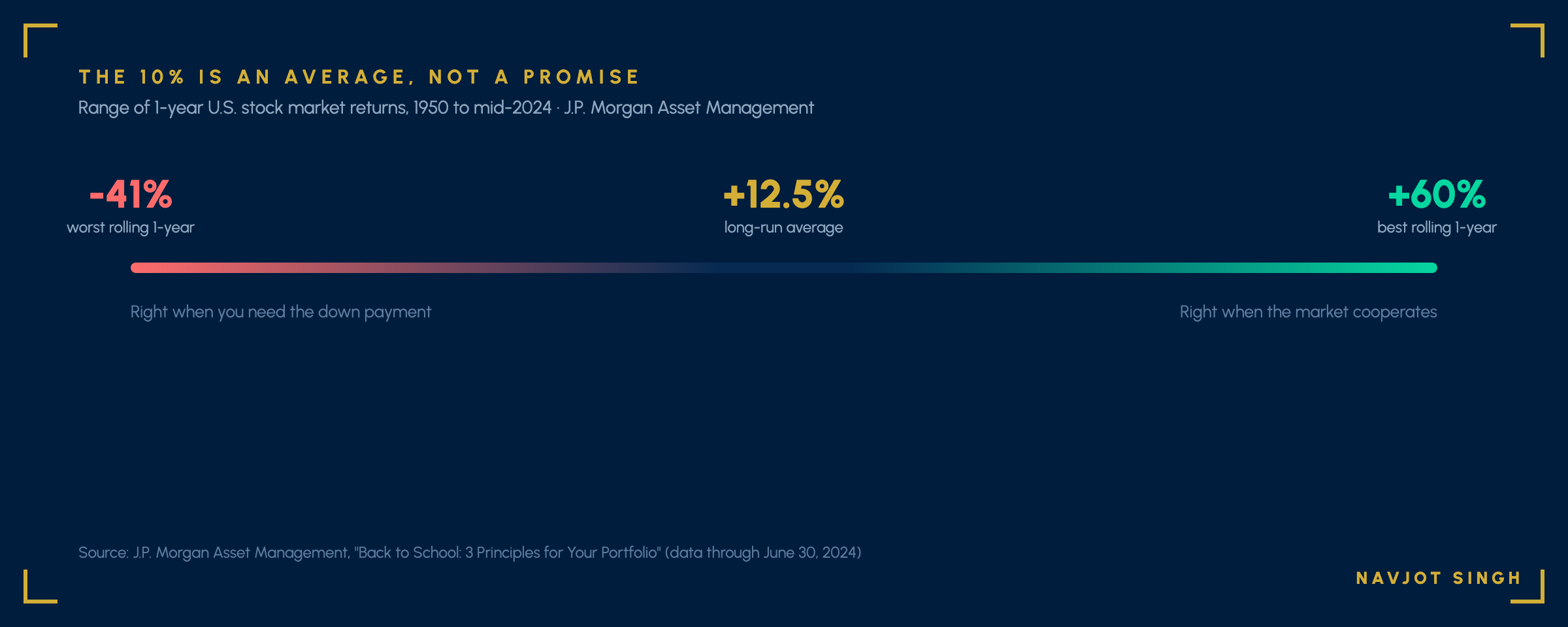
Apply that range to a 24-month down payment fund and the risk becomes concrete: if the market delivers its long-run average, you save two months. If it delivers a year like 1974 or 2008 right before closing, you could be short of your target at exactly the moment you need the money most, with no time left to wait out a recovery. That's sequence-of-returns risk, and it's the specific danger of investing money on a short, fixed deadline rather than an open-ended one.
A Framework, Not a Verdict
The honest answer depends on your actual timeline, and it splits into three zones.
- Buying within 12 months: keep it in cash-equivalents — a high-interest savings account or a short GIC inside your FHSA or TFSA. There isn't enough runway to recover from a bad stretch, and the yield gap versus investing is small.
- Buying in 1 to 3 years: this is the zone the math above describes. A safe, guaranteed vehicle captures most of the practical benefit with none of the sequence-of-returns risk. If you invest at all in this window, treat it as a small portion of the total, not the whole fund.
- Buying in 3 to 5+ years: there's enough time to ride out a bad year or two before you need the cash, which is when a larger growth allocation starts to make sense — still a conversation for a financial advisor who can look at your full picture, not a blog post.
This time-horizon-matching principle isn't unique to real estate — it's standard financial-planning guidance for any goal with a fixed deadline. The shorter your runway, the less your plan should depend on the market cooperating.
Where This Argument Has Limits
The -41%/+60% range comes from U.S. stock market history, not the Canadian market specifically, and the 4% "safe" rate is tied to today's Bank of Canada policy rate — both GIC/HISA yields and equity return assumptions will shift as rates move. The $4,000-a-month scenario is also a large, specific contribution amount; the smaller your monthly contribution, the more months of compounding you need before the rate of return starts to matter more than the rate of saving. And every dollar figure here assumes monthly compounding with contributions at the start of each month — change any of those assumptions and the exact numbers shift, even though the underlying pattern holds.
Frequently Asked Questions
Can I use my FHSA and TFSA and the RRSP Home Buyers' Plan all at once?
What happens to my FHSA if I don't end up buying a home?
Is a GIC or a high-interest savings account better for a short-term down payment fund?
Why does the return rate matter so little over just 24 months?
The Takeaway
For a down payment you need within a couple of years, the account you use (FHSA, TFSA, RRSP-HBP) and the amount you consistently save both matter more than whether you chase a higher return. Use the accounts built for this, keep the money in something safe if your timeline is under three years, and get real financial advice before deciding how much of it, if any, belongs in the market.
If you want help translating your specific savings number into what it actually gets you in today's market, reach out through navjotchahal.ca or contact Navjot Singh directly.
Recent Posts