
The Strait of Hormuz Is Setting Your Cap Rate
The Strait of Hormuz Is Setting Your Cap Rate
Most industrial buyers underwrite today's interest rate as a fixed input, the way you'd underwrite a zoning bylaw or a lot size. It's on the term sheet, so it's treated as settled. It isn't. On February 28, 2026, a Middle East war closed the Strait of Hormuz. That single event is the reason the Bank of Canada is holding, not cutting, and the reason your next industrial offer needs a wider margin than the rate sheet suggests.
This isn't a thought experiment about a strait that might get disrupted someday. Iran declared the strait closed on March 4, 2026. Traffic through it was near zero by early May. The shock already happened, it's still running through the system, and most buyers evaluating a Breslau flex building this month are still pricing the borrowing cost as if it came from nowhere in particular.
As of this writing, roughly 6,000 seafarers remain trapped in the region and strait traffic has not normalized. This is an active situation, not a resolved one — treat every figure below as a snapshot, not a forecast.
The Circuit: How a Strait Becomes a Cap Rate
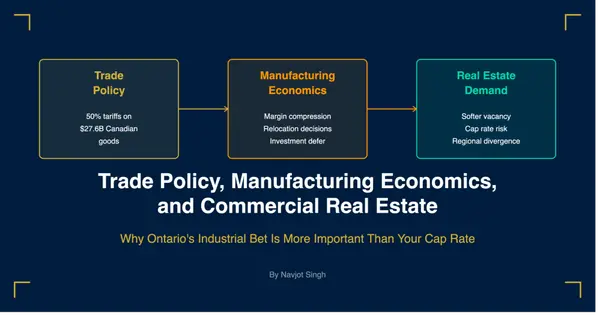
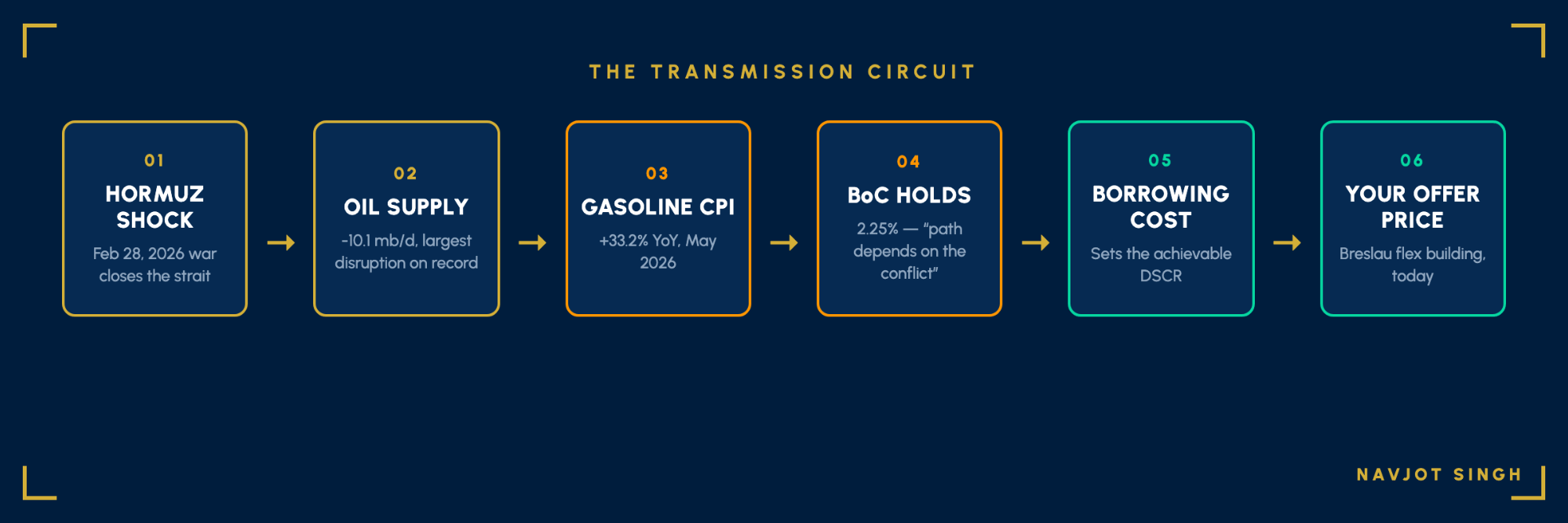
Think of it as a circuit, not a headline. Six components, each one setting the input for the next. Break it at any node and the analysis changes — which is exactly why most underwriting misses it.
Node 1-2: The Physical Shock
Roughly a quarter of the world's seaborne oil and a fifth of global LNG normally transits Hormuz. When the strait closed, global oil supply fell by 10.1 million barrels a day to 97 mb/d in March 2026 — described by the International Energy Agency as the largest single disruption in the oil market's history. Gulf producers cut output by at least 10 mb/d as flows collapsed from roughly 20 mb/d to what the IEA called "a trickle."
Node 3: The Inflation Print
Gasoline makes up 3.30% of the Canadian CPI basket on 2025 expenditure weights, according to Statistics Canada's 2026 basket update. That's a small slice of the basket with an outsized ability to move the headline number. Gasoline prices rose 33.2% year over year in May 2026, and Statistics Canada's own release attributed May's 3.2% headline inflation print directly to "higher gasoline prices linked to the war in the Middle East" — with inflation excluding gasoline running a full percentage point cooler, at 2.2%. By June, gasoline's year-over-year increase had eased to 20.5% as an interim ceasefire arrangement cooled global oil prices, and headline CPI cooled with it to 2.8%.
Node 4: The Policy Response
The Bank of Canada held its policy rate at 2.25% on July 15, 2026. Read the announcement and the causal chain is explicit, not inferred: the Bank cited "higher oil prices stemming from the Middle East conflict" as a drag on global prospects, and said directly that "the path for global inflation is highly dependent on how the conflict unfolds." That is a central bank telling you, in writing, that its policy rate is downstream of a war in a strait 11,000 kilometres from Breslau.
Node 5-6: Borrowing Cost to Offer Price
A held policy rate doesn't mean a stable borrowing environment. Five-year Government of Canada bond yields, which anchor most commercial mortgage pricing, moved from roughly 2.99% in June to a spike near 3.18% in early July on renewed tensions before easing back toward 3.13%. That's the input your lender uses to price your loan, and it's been trading like a security tied to Iranian strait policy — because functionally, right now, it is.
Two Constraints, One Ceiling
Most underwriting treats a rate move as a single line item on the mortgage payment. It's actually two separate ceilings on the maximum price you can pay, moving at once, and the lower of the two wins.
The figures below are a worked example built from public methodology, not a reported market statistic. They use an illustrative $300,000 NOI, a 1.25x minimum debt service coverage ratio, 25-year amortization, and a $1.5M equity check — adjust the inputs to your own deal before relying on the output.
Channel One: The Appraisal Ceiling (Cap Rate)
CBRE Econometric Advisors found that industrial cap rates move roughly 41 basis points for every 100 basis points of change in benchmark yields — the least sensitive of any major property type, well behind office (70 bps), multifamily (75 bps), and retail (78 bps). That CBRE relationship is U.S. Treasury-based and dated October 2024; treat it as the best available directional sensitivity for Canadian industrial, not a precise Canadian coefficient.
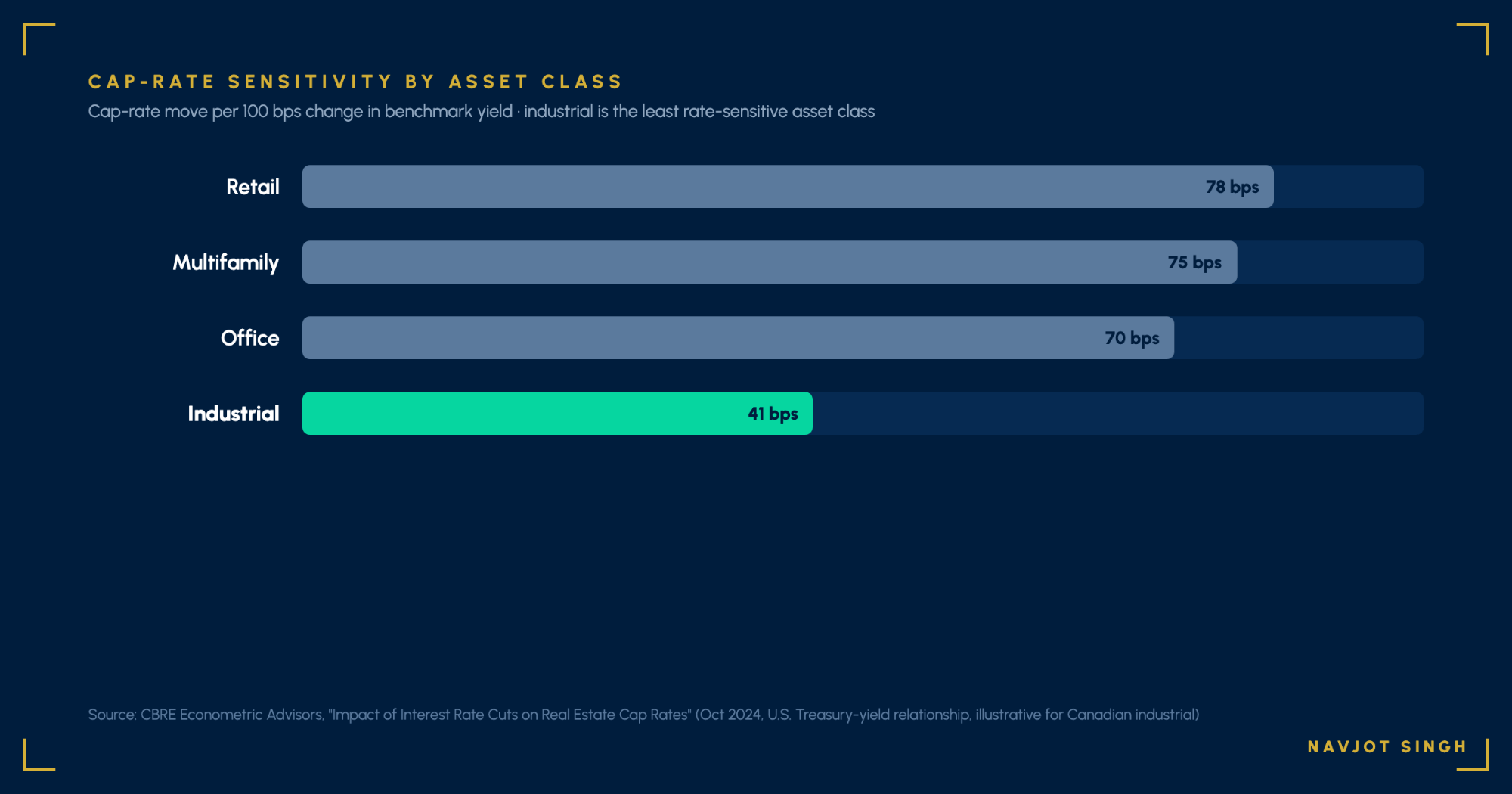
Applied to our illustrative deal: at a 6.00% cap rate, $300,000 in NOI supports a $5.0M valuation. Push the cap rate out by the industrial-specific 41 bps and it supports about $4.68M — a roughly $320,000 haircut on appraised value alone, before a single financing term changes.
Channel Two: The Financing Ceiling (DSCR)
The debt service coverage ratio channel is separate, and it usually binds harder. DSCR equals NOI divided by annual debt service, and most 2026 commercial lenders require a minimum of 1.20x to 1.25x. At our illustrative $300,000 NOI and a 1.25x floor, maximum annual debt service is capped at $240,000 regardless of what the appraisal says.
Run that $240,000 through a 25-year amortization at a 5.50% rate and it supports roughly $3.26M of debt. Run the same $240,000 through the same amortization at 6.50% — a 100 bps move consistent with the bond-yield swing above — and supportable debt falls to about $2.96M. Add the same $1.5M equity check to both, and your financeable ceiling drops from about $4.76M to about $4.46M.
| Constraint | Before (5.50%) | After (+100 bps) | Movement |
|---|---|---|---|
| Cap-rate ceiling (appraisal) | $5.00M | $4.68M | −$320K |
| DSCR ceiling (financing) | $4.76M | $4.46M | −$300K |
| Binding ceiling | $4.76M | $4.46M | −$300K (−6.3%) |
Whichever ceiling is lower wins, every time. Before the rate move, financing was the looser constraint. After it, financing binds tighter than the appraisal does. Most buyers keep watching the cap rate and never notice the moment the real constraint switched channels.
Why the Demand Side Complicates the Story
If industrial fundamentals were soft, this would be a simpler, gloomier post: rates up, values down, done. They aren't soft. Waterloo Region logged 1,151,740 square feet of net industrial absorption in Q1 2026, the strongest quarter since Q4 2023 and roughly a quarter of the entire national total, second only to Toronto. New supply delivered was 86.6% pre-leased before it was even finished. Southwestern Ontario industrial availability improved 40 basis points year over year to 7.2%.
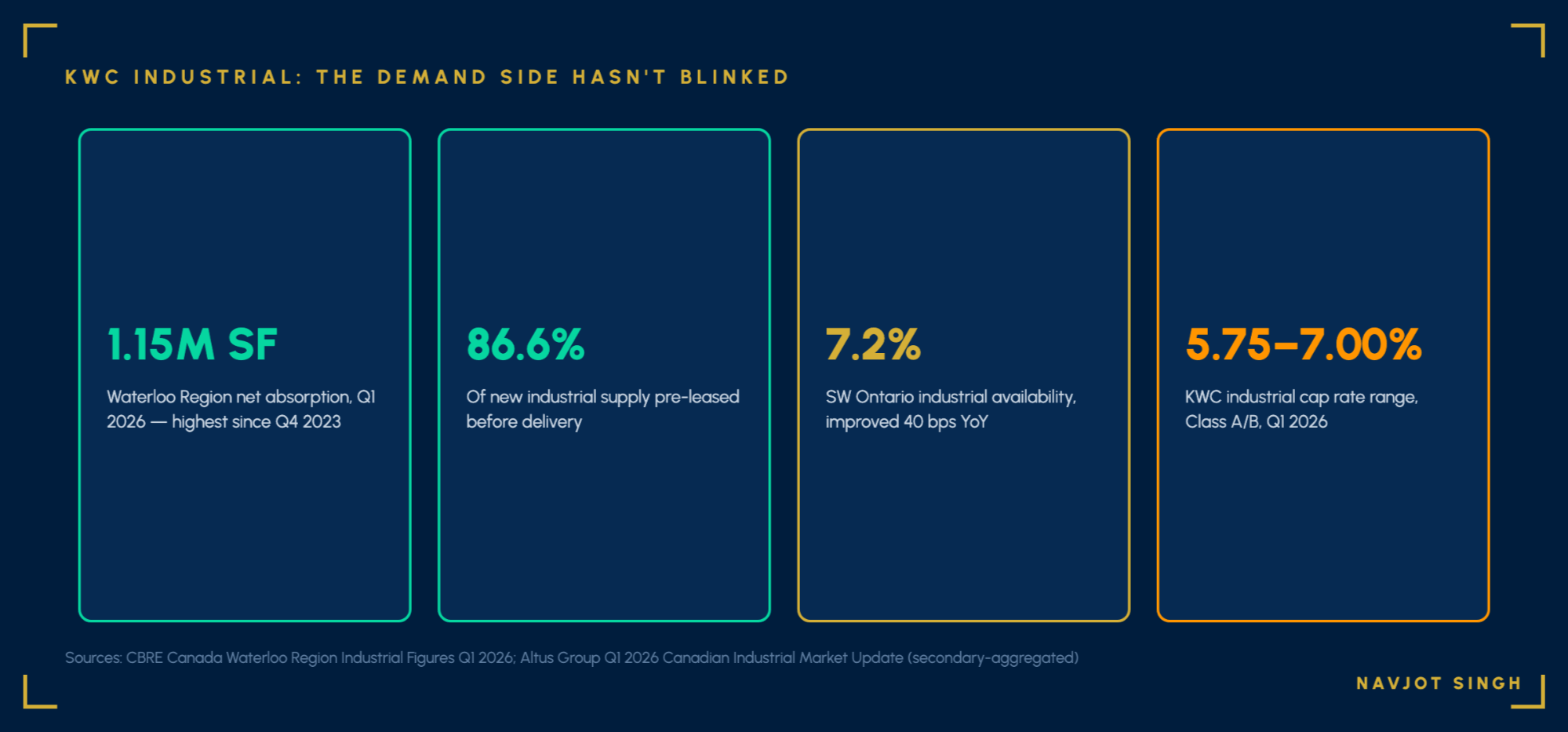
Most investors are underwriting today's rate as the stable base case for their hold period. The circuit above says that's backwards: the rate itself is a geopolitical variable in disguise, and the fundamentals underneath it haven't moved. If you can hold through the noisy channel, the demand channel is doing exactly what you want it to.
KWC industrial cap rates are currently reported in the 5.75% to 7.00% range across Class A and B product, per Q1 2026 market commentary aggregating CBRE and Altus Group data. Treat that range as secondary-sourced — the primary CBRE and Altus reports were not independently re-verified line by line for this piece, so use it as a directional band, not a precise appraisal input.
Breslau Specifically
Breslau sits in Woolwich Township, directly adjacent to the Region of Waterloo International Airport, and it's the specific node where this argument gets concrete. The Township's own Breslau Staging consultation explicitly exempts industrial and airport lands from the residential staging policy governing the area's roughly 400% approved urban expansion — industrial parcels follow a separate, services-based approval track. No major brokerage has published a Breslau-specific cap rate; every industrial figure above is regional. For scale, one 13-acre M1-zoned parcel directly across from the airport is currently listed for lease in the $5,000 to $15,000 per month range — illustrative of what's on the market, not a market statistic.
Where This Argument Could Be Wrong
The honest caveats matter more than the confident parts. The CBRE cap-rate sensitivity is a U.S. Treasury-yield relationship from October 2024, applied here to a Canadian industrial asset in 2026 — directionally useful, not a precise transplant. The exact Hormuz crisis timeline (closure date, traffic-to-zero date, seafarers-trapped count) traces to aggregated wire reporting rather than a single primary source, so treat specific dates as approximate. Commercial mortgage rate ranges used in the worked example come from lender-marketing commentary, not a primary bank rate sheet — your actual quote will vary by lender and covenant package. And the worked example itself is a model built for this piece, not a transaction anyone has actually closed.
None of that weakens the core claim. The Bank of Canada said, in its own words, that its rate path depends on how a war in the Middle East unfolds — a line from the policy announcement itself, not a modeled assumption.
Frequently Asked Questions
Isn't the Bank of Canada's rate decision about domestic inflation, not foreign oil shocks?
If gasoline is only 3.3% of the CPI basket, how much can it really move the headline number?
Does this mean industrial cap rates in KWC are about to widen sharply?
What should I actually do with this if I'm evaluating a Breslau industrial property right now?
The Takeaway
Today's interest rate is the current reading on a circuit that starts with tanker traffic through a strait most buyers couldn't find on a map, not a number you can pencil in and forget. The Bank of Canada said as much directly. If you're underwriting a Breslau flex building, an industrial site near the airport, or any KWC industrial asset this quarter, model both ceilings, stress-test the financing side against a further rate move, and treat the fundamentals — which remain genuinely strong — as the reason to still be at the table, not the reason to skip the stress test.
If you're evaluating industrial or flex-industrial property in KWC and want help running both ceilings against a specific deal, reach out through navjotchahal.ca or contact Navjot Singh directly.
Recent Posts