
The Manufacturing Jobs Number Everyone Is Reading Wrong
The Manufacturing Jobs Number Everyone Is Reading Wrong
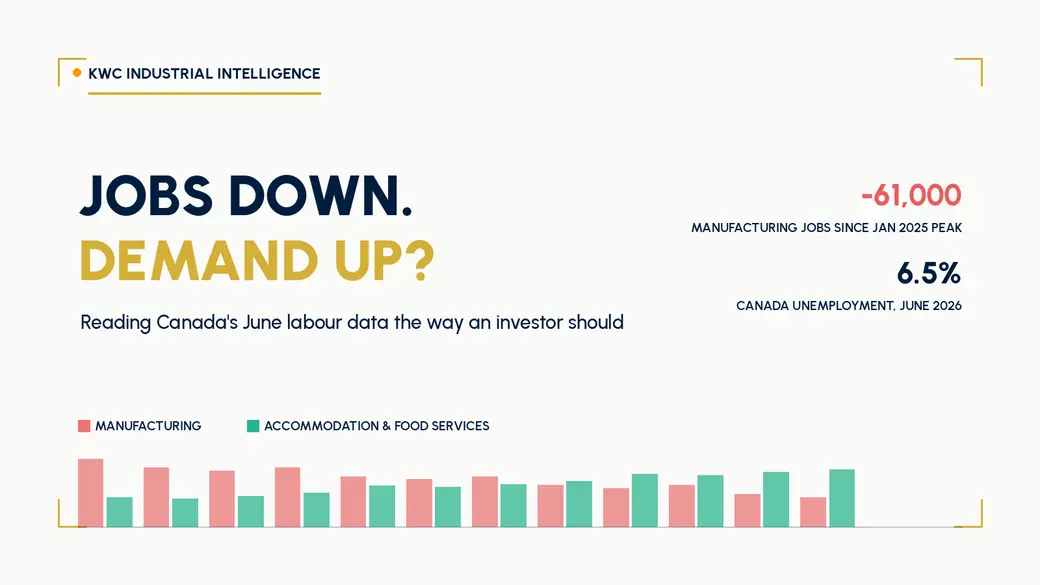
Canada added 18,000 jobs in June 2026, holding the unemployment rate at 6.5 percent, down for a second straight month. Manufacturing did not share in that. It lost 17,000 jobs in June, part of a net decline of 61,000 jobs since manufacturing employment peaked in January 2025, a drop tied to more than a year of tariff-related uncertainty.
Ontario, meanwhile, held its ground. Employment barely moved in June, but that followed a cumulative gain of 84,000 jobs over the two prior months. The provincial unemployment rate sat at 7.0 percent, unchanged from May and down 0.8 percentage points from a year earlier. In the Toronto CMA, unemployment held at 6.9 percent, continuing a downward trend from a February high of 8.5 percent.
Put those two facts next to each other and most people draw one conclusion: manufacturing is shrinking, so industrial space demand must be shrinking with it. That conclusion is wrong more often than it is right.
What the June numbers actually say
Two things stand out. First, the manufacturing decline is not new. It has been building for eighteen months, driven by a specific and identifiable cause: tariff exposure, not a broad demand collapse. Second, Ontario's labour market did not reverse in June. It paused after two strong months. A pause after a run and a rollover after a peak are different signals, and they call for different responses.
Why job losses in a sector don't mean falling demand for its buildings
Sector-wide job losses are rarely evenly distributed across every company in that sector. When a sector faces sustained cost pressure, like tariffs, the weakest operators cut staff, shrink footprint, or exit entirely. The stronger operators in the same sector often do the opposite. They pick up market share, absorb customers the weaker operators can no longer serve, and in some cases physically take over the space and equipment the exiting operators leave behind.
That is not contraction. That is consolidation. The jobs number captures net headcount across the whole sector. It does not tell you which companies are shedding staff and which are hiring the displaced workers, buying the discounted equipment, or leasing the vacated space.
What this means for KWC industrial real estate
Kitchener-Waterloo-Cambridge carries meaningful manufacturing exposure, which makes this distinction more than academic. If you are underwriting an industrial asset, evaluating a tenant, or advising a client on either side of a deal, three things matter more right now than the headline jobs number:
- Tenant trajectory over tenant headcount. A manufacturer with flat or growing headcount inside a shrinking sector is often the operator absorbing weaker competitors' customers and capacity. That is a stronger covenant than the sector average suggests.
- Vacated space is not always a vacancy problem. When a weaker operator exits, their building does not necessarily sit empty. It is a candidate for absorption by the stronger operators in the same corridor, particularly where utility capacity, ceiling heights, or loading configuration already fit the use.
- Ontario's pause is not a warning yet. A flat month after a strong two-month run is normal variation, not a trend reversal. One flat print does not change the underwriting.
None of this means manufacturing pressure is irrelevant. Tariff-driven cost increases are real, and a tenant that is losing money will eventually stop paying rent regardless of what the sector average shows. The point is that the sector-level number tells you a story is happening. It does not tell you which side of that story your specific asset or tenant is on. That requires looking at the tenant directly, not the headline.
Source: Statistics Canada, The Daily, Labour Force Survey, June 2026, released July 10, 2026.
Recent Posts