
The Federal Loan Guarantee That Keeps Your House Out of the Deal
Commercial Financing · KWC + GTA
The Federal Loan Guarantee That Keeps Your House Out of the Deal
How the Canada Small Business Financing Program works, what it really costs, and how to line it up with your next commercial lease or purchase.
When I tour commercial units with clients opening a restaurant, a franchise or a shop, the first worry is the landlord. The second is the build-out: kitchen exhaust, washrooms, storefront, HVAC. Then the bank looks at the numbers and asks for the house.
There is a federal program built for exactly that moment, and most owners have never heard of it. In a 2023-24 study done for Innovation, Science and Economic Development Canada (ISED), only 16% of eligible businesses that hadn't used the program knew it existed. Among businesses that already had one of these loans, only 34% said they were aware of the program when it was named.
It's called the Canada Small Business Financing Program (CSBFP). Below I explain how it works, where it fits in a commercial lease or purchase, and where owners go wrong.
Key takeaways
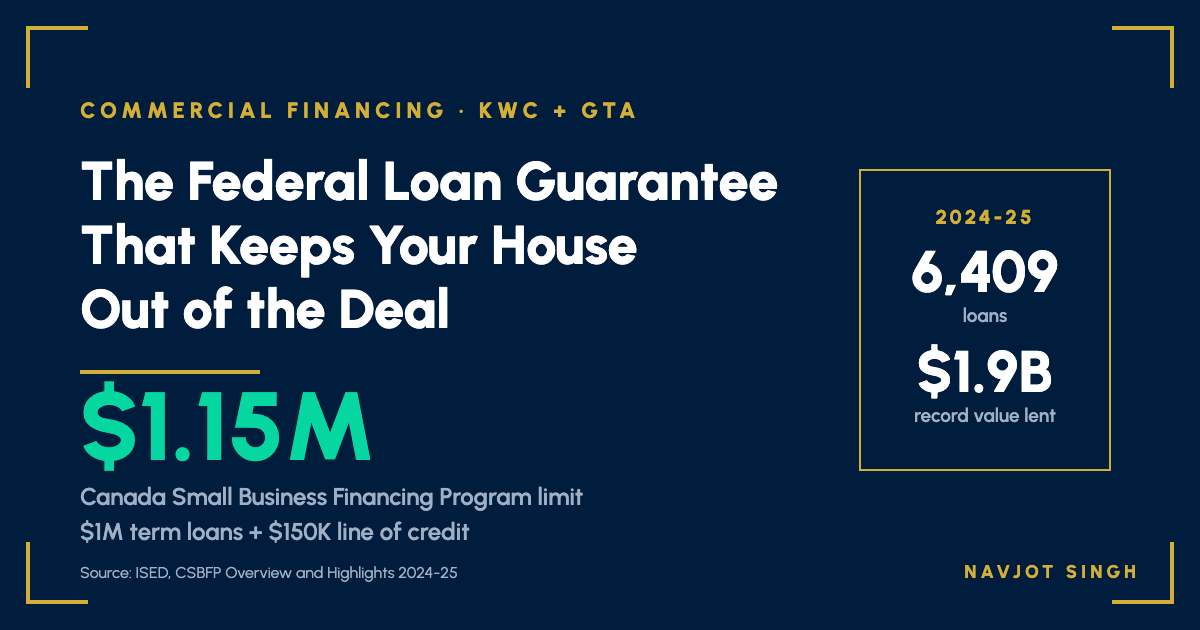
- The CSBFP is a federal guarantee on a loan from your own bank or credit union. It is not a grant. The maximum is $1.15M: $1M in term loans plus a $150K line of credit.
- A personal guarantee on a CSBFP loan has to be unsecured, so you can't pledge your home as security for it.
- Leasehold improvements took 64.6% of the roughly $1.9B lent in 2024-25.
- Expect a 2% registration fee. Interest is capped at prime + 3% on floating-rate term loans and prime + 5% on lines of credit.
- Delivery of the program is moving from ISED to BDC. As of October 2026, no transfer date has been published.
What is the CSBFP?
The CSBFP is a federal loan guarantee, not a government loan. You apply to your own bank or credit union. The lender makes the credit decision and registers the loan with ISED. If the loan defaults, the lender first sells the assets it financed, and then the program pays the lender 85% of the remaining eligible loss.
That guarantee is the whole point. It reduces the lender's risk on borrowers who would otherwise be declined or offered worse terms. The typical case is a new operator with a solid plan and not much collateral.
Eligibility is broad: businesses with gross annual revenue of $10 million or less, in any industry except farming.
How much can you borrow, and for what?
The total limit is $1.15 million per borrower: up to $1 million in term loans plus a $150,000 line of credit. The caps inside the $1 million are nested, not added together. Real property can use the full $1 million. Leasehold improvements and equipment share a $500,000 cap. Intangibles and working capital are capped at $150,000, and that sits inside the $500,000.
| What you're financing | Limit |
|---|---|
| Real property (buying your premises) | Up to $1,000,000 |
| Leasehold improvements + equipment, combined | Up to $500,000 |
| Intangibles + working capital (inside the $500K) | Up to $150,000 |
| Line of credit (separate from term loans) | Up to $150,000 |
| Maximum term, any term loan | 15 years |
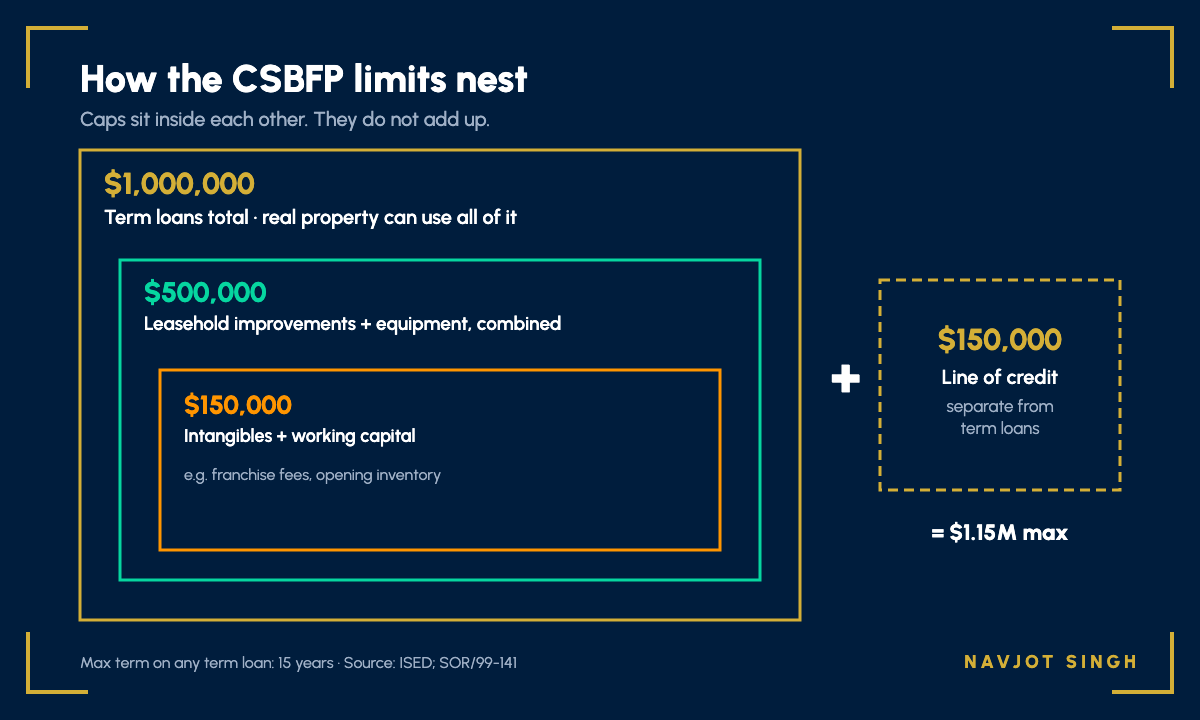
Plan the whole financing package before you sign anything, because the caps nest. Say a buyer wants an $850,000 commercial condo unit plus $300,000 of improvements. That's $1.15 million of term borrowing, which is over the $1 million limit before a single piece of equipment is added.
Who is actually using it?
In 2024-25, lenders made 6,409 CSBFP loans worth about $1.9 billion. ISED says that's the largest dollar value in the program's history. The average loan was $294,067. Most of the money went to the kind of businesses that lease storefronts and restaurant space.
- Accommodation and food services: 47.8% of the value lent, about $900.9 million
- Retail: 15.0%, about $282.3 million
- Ontario: 2,957 loans worth $922.3 million, or 48.9% of the national total
- Start-ups and businesses under a year old: 74.1% of all financing
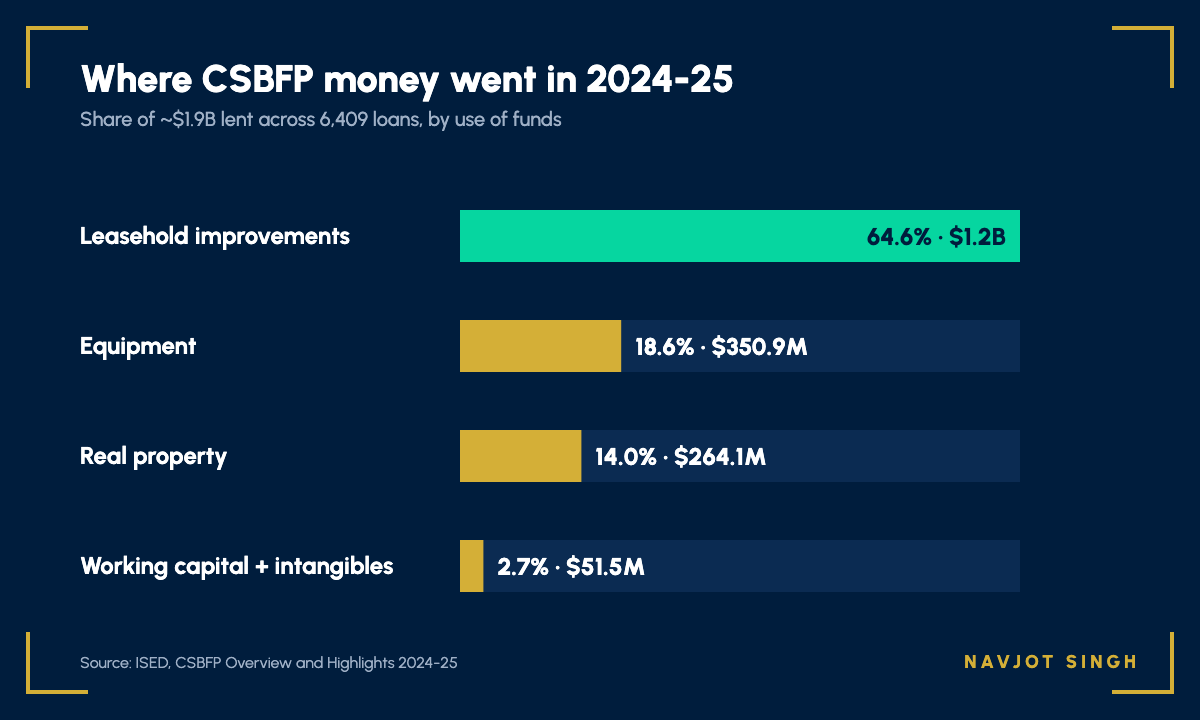
The real estate signal: about two out of every three dollars ($1.2 billion, or 64.6%) went into leasehold improvements. That's the work that turns an empty unit into a working business. So this is as much a commercial leasing story as a financing one.
Why does the personal guarantee rule matter so much?
Lenders can ask for a personal guarantee of up to the original loan amount, but it has to be unsecured. The lender takes its security on business assets: the property or equipment it financed, or other business assets for leasehold improvements, working capital and lines of credit. It can't take a charge on your family home to back the guarantee.
The usual advice is "put up the house, that's how everyone starts." For a qualifying deal, that's backwards. A structure exists that keeps the house from being pledged on day one.
Unsecured doesn't mean risk-free. You're still personally liable for the guaranteed amount. If the guarantee is called, the lender can pursue you through the courts the way any unsecured creditor can. Also check whether the bank splits your financing into a CSBFP loan and a separate conventional loan. The conventional loan can still come with a mortgage on your home. Have your lawyer read the guarantee before you sign it.
How does the CSBFP fit a commercial lease?
Leasehold improvements are permanent work inside someone else's building, so to a lender they're only worth something while you have the right to stay in the space. That's why the lease and the loan have to be designed together, and I build this into the offer stage:
- Match the lease term to the loan term. If your build-out loan runs 10 years but your lease runs 5 with no renewal option, sort out that gap before you sign. Renewal options are cheap to negotiate up front and expensive to add later.
- Get landlord contributions first, then borrow for the gap. Negotiate the tenant improvement allowance and the rent-free fixturing period before you size the loan. Every dollar the landlord funds is a dollar you don't pay the 2% fee or interest on.
- Make the offer to lease conditional on financing. Leave the lender enough working days to approve and register the loan. A tight condition date forces you either to waive the condition or to lose the unit.
- If you're buying instead of leasing, real property can use the full $1 million term limit, with a maximum term of 15 years. The lender takes security on the property being financed.
What does it really cost?
The CSBFP isn't a discount product. There's a registration fee of 2% of the loan amount, which can be built into the loan, and the lender can charge its usual fees. Interest rates are capped, but the caps are ceilings, not the price you're guaranteed:
| Loan type | Maximum rate |
|---|---|
| Floating-rate term loan | Lender's prime + 3% |
| Fixed-rate term loan | Lender's residential mortgage rate for the same term + 3% |
| Line of credit | Lender's prime + 5% |
On a $400,000 build-out loan, the registration fee alone is $8,000. Borrowers notice the cost. In the same ISED study, only 19% of borrowers were satisfied with the interest rate and 28% with the registration fee. Compare the total cost against a conventional offer, not just the rate, and include what you're putting at risk on each side.
Which paperwork mistakes can sink the guarantee?
Your lender only gets paid on a claim if the loan was set up correctly. A lender that doubts it could claim will charge more or decline the loan. ISED's guidance for lenders lists these traps:
- Borrow through the operating company. A loan made to a holding company instead of the business that operates is an ineligible borrower, and that can make the claim invalid.
- Get appraisals for family deals. If you buy assets from a relative or a company they control, the lender needs an independent appraisal. The same applies when you buy an existing business as a going concern.
- Don't spend first and finance later. Costs incurred more than 365 days before the loan is approved aren't eligible.
- Keep every invoice and proof of payment in the business's name. If they're missing, the claim can be reduced.
What changes when BDC takes over?
Budget 2025 announced that delivery of the CSBFP will move from ISED to the Business Development Bank of Canada. ISED's November 2025 bulletin says the program continues to run as usual in the meantime. As of October 2026, ISED's site doesn't give a transfer date.
The current rules are known; the new process isn't. If you have a lease, purchase or build-out planned in the next 12 months, start the conversation with your lender under the rules that exist today.
Frequently asked questions
Is the CSBFP a grant?
No. It's a federal guarantee on a regular loan from your bank or credit union. You repay the full loan with interest. The guarantee protects the lender, which makes it more willing to lend to businesses with limited collateral.
Can I use the CSBFP to buy a commercial property?
Yes. Real property can use the full $1 million term loan limit, with a maximum term of 15 years. The lender takes security on the property being financed, and the business must meet the $10 million revenue limit.
Can a franchise or restaurant use the CSBFP?
Yes. Any business with gross annual revenue of $10 million or less qualifies, except farms. In 2024-25, accommodation and food services received 47.8% of all CSBFP loan value, the largest share of any sector.
Can the bank take my house as security on a CSBFP loan?
Not for the CSBFP personal guarantee. Lenders can ask for a personal guarantee up to the original loan amount, but it must be unsecured. You're still personally liable, and any separate conventional loan can still be secured on your home.
Will my bank offer the CSBFP automatically?
Not necessarily. The lender decides whether to register a loan under the program, and awareness is low even among borrowers. Ask your lender directly whether your financing can be done under the Canada Small Business Financing Program.
Shortlisting a unit for a restaurant, franchise or shop in KWC or the GTA? I can help you structure the offer to lease or purchase so that the financing condition, landlord contributions and lease term all fit what your lender needs. Book a call with Navjot.
Sources
- ISED, CSBFP Overview and Highlights 2024-25 (modified December 9, 2025; retrieved October 15, 2026)
- ISED / EKOS Research Associates and Ference & Company, Borrower Awareness and Satisfaction Study 2023-2024 (January 2024)
- ISED, Helping small businesses get loans (modified June 22, 2026)
- Justice Laws, Canada Small Business Financing Regulations, SOR/99-141 (current to September 21, 2026)
- ISED, CSBFP Frequently Asked Questions for Lenders
- ISED, CSBFP Bulletin, April 2014 (personal guarantee rules)
- ISED, CSBFP Bulletin: Federal Budget (November 2025)
Recent Posts