
Waterloo Region Real Estate Market 2026: Local Outlook for Buyers, Sellers, and Investors

Waterloo Region Real Estate Market 2026: Local Outlook for Buyers, Sellers, and Investors
Waterloo Region’s housing market in 2026 is more balanced than it was during the frenzy years. Inventory has improved, buyers have more room to negotiate, and sellers need sharper pricing and presentation to stand out.
Waterloo Region’s market has shifted
If you’re trying to understand the Waterloo Region real estate market in 2026, the clearest takeaway is this: the market has slowed, inventory has improved, and buyers have more leverage than they had during the frenzy years.
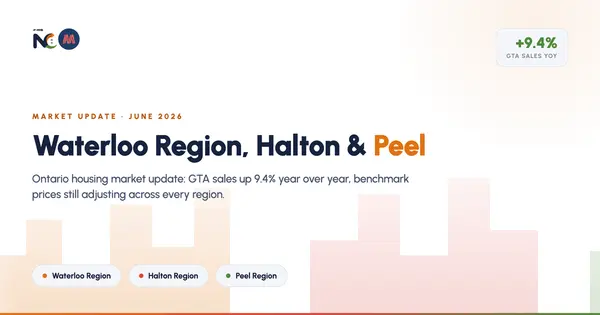
Across the three core cities, there were 664 sales in Kitchener, 349 in Cambridge, and 349 in Waterloo in March 2026, all down from February as buyers stayed cautious and took longer to make decisions.
National housing trends still matter locally
Waterloo Region does not move in isolation. Nationally, recent data shows housing activity across Canada stayed quiet into early 2026, with home sales lower than a year earlier and the national benchmark price modestly weaker on an annual basis.
Broader forecasts for 2026 point to slower economic growth, softer population gains, and mortgage renewal pressure as key headwinds for buyers. That backdrop is one reason many Waterloo Region households are more cautious about stretching their budgets this year.
What the latest Waterloo Region numbers show
The latest local data points to a market with more balance, but not equal conditions across every city. Overall supply in early 2026 sits around the three-month mark, but Kitchener, Waterloo, and Cambridge are not behaving identically.
How Kitchener, Waterloo, and Cambridge compare
Looking at individual cities, the story becomes even clearer. In March 2026:
- Kitchener recorded 664 sales, about 2.9 months of supply, roughly 206 homes for sale, and an average sale price of $691,958.
- Cambridge saw 349 sales, about 2.8 months of supply, 113 homes for sale, and an average sale price of $726,512.
- Waterloo also had 349 sales, with the highest supply at roughly 3.2 months, around 104 homes for sale, and an average sale price of $759,712.
Taken together, the February-to-March data shows a market that is cooling in sales activity, seeing more selection in some areas, and adjusting on price through modest month-to-month moves rather than sharp corrections.
Prices are softer, but not collapsing
One of the biggest misconceptions in today’s market is that softer conditions automatically mean a dramatic price crash. That is not what the latest numbers show.
On a city level, March 2026 average sale prices came in around $691,958 in Kitchener, $726,512 in Cambridge, and $759,712 in Waterloo, each down modestly from February but nowhere near a free fall.
The same pattern appears when you zoom out nationally: prices are weaker than a year ago in several Ontario markets, but they are not moving in one straight line. Neighbourhood, property type, condition, and price range all matter more now than headline averages.
What buyers should know in 2026
For buyers, this is one of the more usable markets we’ve seen in years. More listings and less urgency give you time to compare homes, negotiate conditions, and focus on long-term fit instead of reacting under pressure.
The trade-off is affordability. Higher rates, tighter qualification, and concerns about future payments still matter, especially for first-time buyers and those moving up in price point.
What sellers need to understand
Sellers can still succeed in Waterloo Region, but the strategy has to be sharper. Buyers now have options, and they are more sensitive to price, condition, layout, condo fees, and financing risk than they were in a low-rate environment.
Overpricing is more likely to lead to longer time on market, more price reductions, and weaker negotiating power. The listings that perform best are typically the ones that are prepared well, positioned correctly, and launched with a clear plan from day one.
What this means for investors
For investors, 2026 is a year for discipline. As rental markets move toward better balance and rent growth slows in some areas, aggressive assumptions on appreciation or rent increases deserve more caution than they did a few years ago.
In Waterloo Region, the better approach is to focus on realistic rents, financing resilience, vacancy risk, and property selection. Strong long-term fundamentals still matter, but weak underwriting is harder to hide in a slower cycle.
Why Waterloo Region still matters long term
Even in a slower market, Waterloo Region remains one of Ontario’s more important housing areas because of its universities, employment base, innovation economy, and relative affordability compared with the GTA.
That does not remove short-term pressure, but it does explain why the region continues to attract buyers, families, and investors looking for long-term value. In today’s market, the opportunity is still there; it just requires more strategy than speed.
Need a Waterloo Region market breakdown for your situation?
If you’re planning to buy, sell, or invest in Kitchener, Waterloo, Cambridge, or the surrounding area, I can help you understand what the current numbers mean for your specific goals and neighbourhood.
Book a ConversationThis article is based on recent February–March 2026 statistics for Kitchener, Waterloo, and Cambridge, alongside broader Canadian housing outlook data available at the time of writing. Real estate trends change monthly, and neighbourhood-level performance may differ from regional averages.
Recent Posts